In this article
- What palm oil is
- Why manufacturers use it
- Where you will find it
- The saturated-fat question: what it does to cholesterol
- Infant formula: the calcium question
- Processing contaminants: 3-MCPD and glycidyl esters
- Red palm oil is not the same product
- The rainforest question: deforestation and certification
- What regulators say
- The debate
- Who should avoid it
- How to spot it on a label
- Alternatives: what replaces it
- Frequently asked questions
Palm oil is about half saturated fat — roughly the same share as butter, three to seven times the share in olive or canola oil — and that single fact drives most of the health story: in trials it raises LDL cholesterol by about 0.24 mmol/L versus oils low in saturated fat, while also raising HDL, so the cholesterol ratios barely move; there is no trial showing it causes heart attacks. Its second story is in the baby bottle: palm olein in formula measurably lowers fat and calcium absorption — calcium absorption was 37.5% versus 57.4% in the best-controlled trial — and bone mineralisation in the first six months, with firmer stools — effects that appear short-term, and that Europe's paediatric society says do not justify avoiding it, a verdict other researchers formally disputed. Its third story is the one most people miss: refined palm oil carries the highest levels of the processing contaminants 3-MCPD and glycidyl esters, which the EU now caps by law, with the tightest limits on infant formula. And its fourth story is the forest: oil palm was the largest single driver of deforestation in Indonesia from 2001 to 2016, at 23% — though it is also the highest-yielding oil crop on Earth, which is why simply boycotting it would need more land, not less.
What palm oil is
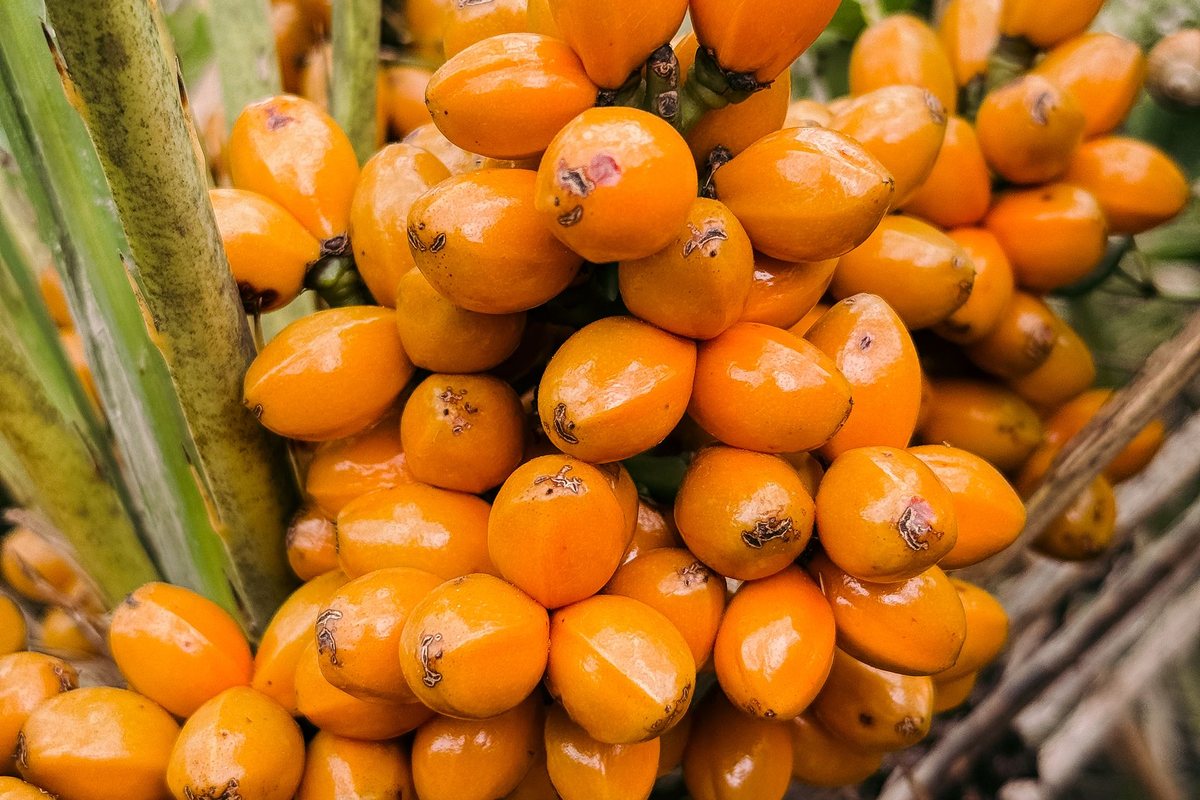
Palm oil is pressed from the fleshy fruit — the mesocarp — of the oil palm, Elaeis guineensis. One fruit gives two different oils: palm oil from the flesh, and palm kernel oil from the seed inside. They are not the same ingredient, and the difference matters for everything that follows. Palm oil is about 49% saturated fat (the US Department of Agriculture's figures: 49.3% saturated, 37.0% monounsaturated, 9.3% polyunsaturated), with palmitic acid at 39.5–47.5% of the total fatty acids. Palm kernel oil is about 86% saturated fat, dominated by lauric acid at around 48% — compositionally a "lauric oil" like coconut oil, not like palm oil.
Two more names appear on labels and in formula research. Palm olein is the liquid fraction of palm oil, separated by cooling and fractionation; palm stearin is the solid fraction. Palm olein is the form most used in infant formula fat blends and as a cooking oil; palm stearin goes into shortenings and margarines. When a study says "palm olein", it means the liquid fraction of palm oil — not a different plant.
The saturated-fat share is the number to hold onto. Palm oil is roughly half saturated fat — about the same share as butter (around 49–51%), roughly three and a half times the share in olive oil (about 14%) and about seven times the share in canola oil (about 7%). That single comparison explains most of the health debate, most of the food industry's interest, and most of the confusion about whether palm oil is "natural" or "processed": it is a natural oil whose fatty-acid profile happens to look like an animal fat.
Tip: "palm oil", "palm kernel oil" and "palm olein" are three different fats from the same fruit. A claim about one does not automatically apply to the others — and the EU's contaminant limits even put palm oil and palm kernel oil in different tiers, as the contaminants section explains.
Why manufacturers use it
Palm oil is popular for the same reason it is hard to notice: it does an unglamorous job cheaply, at scale, without adding flavour, colour or sweetness of its own.
- It is solid without hydrogenation. Because it is naturally about half saturated fat, palm oil is semi-solid at room temperature — so it gives the solid-fat functionality of butter or shortening without partial hydrogenation, which is the process that creates industrial trans fat. After trans-fat bans and limits — the EU caps industrially produced trans fat at 2 g per 100 g of fat — palm oil became the food industry's main replacement fat for partially hydrogenated oils.
- It is cheap and versatile. Oil palm is the highest-yielding oil crop on Earth, at about 2.9 tonnes of oil per hectare against roughly 0.7 for rapeseed or sunflower, and it produces year-round in the tropics. That yield is why it is the world's most-used vegetable oil, and why it turns up in products where a more expensive oil would never be used.
- It is stable and neutral. It keeps well, survives frying and baking, and has little flavour of its own — which is what a biscuit or spread manufacturer wants from a fat.
- It does a second job in formula. Palm oil and palm olein are added to infant formula to mimic the palmitic acid content of human milk — human milk fat is about 20–25% palmitic acid. The catch, as the infant-formula section explains, is the position of that palmitic acid, not its presence.
None of these uses is secret. Palm oil is printed on the label in plain sight in the EU and the US. The reason it lands on a flagged-ingredients list is not that manufacturers hide it, but four specific questions about what it does once it is in the food, in the bottle, and in the forest: saturated fat, infant absorption, refining contaminants, and deforestation. Those are the next five sections.
Where you will find it
About 68% of the world's palm oil goes to food, about 27% to industrial and consumer products (soaps, detergents, cosmetics, cleaning agents), and about 5% to bioenergy. The food share is where a label-reader meets it:
- Biscuits, pastries and cakes — the classic home of palm oil, where its solid-at-room-temperature texture replaces butter or shortening
- Margarine and spreads, including chocolate-hazelnut spread
- Chocolate and confectionery, ice cream, and snack foods
- Instant noodles and fried products
- Infant formula, where palm olein is part of the fat blend
It is declared under its own name in the EU and the US — "palm oil", "palm fat", "vegetable oil (palm)", "palm olein" or "palm stearin" — and sometimes inside a generic "vegetable fat" or "vegetable oil" blend. In Australia and New Zealand it does not have to be named at all, as the labelling section explains. It has no hidden synonym in the EU or US; the hard part is knowing that the same ingredient also appears in products you would never associate with a tropical plantation — a plain biscuit, a tub of spread, a bottle of formula.
The products that matter most for this article are the processed foods and the formula. A biscuit is where the saturated-fat question lives; a bottle of formula is where the calcium question lives; and both are where the refining-contaminant question lives. The same processed foods often carry the other ingredients in this guide's food pool — BHA and BHT keep the same biscuits fresh, and added sugars sweeten them — but each ingredient is a separate question, and this article deals only with the fat.
Related: Added sugars — the sweetener hiding in the same processed foods, and why the numbers disagree.
The saturated-fat question: what it does to cholesterol
This is the central health question about palm oil, and it has a precise, dose-dependent answer — not a slogan in either direction.
The mechanism is the general saturated-fat mechanism, established by Mensink and Katan's 1992 meta-analysis of 27 controlled trials: replacing saturated fat with unsaturated fat gives the most favourable lipoprotein profile for coronary heart disease, and replacing saturated fat with carbohydrate lowers LDL cholesterol by about 0.33 mmol/L (about 13 mg/dL) for every 10% of energy swapped. Palm oil's saturated fat is mostly palmitic acid, and the equations treat it as a generic saturated fat — the paper does not separate palmitic from other saturated fatty acids.
The palm-oil-specific evidence comes from feeding trials, and three meta-analyses tell a consistent story:
- Sun et al. 2015 (Journal of Nutrition). Palm oil significantly increased LDL cholesterol by 0.24 mmol/L (95% CI 0.13–0.35) versus vegetable oils low in saturated fat. The effect was seen in randomised trials (0.31 mmol/L) but not in non-randomised trials (0.03 mmol/L). Palm oil also increased HDL cholesterol by 0.02 mmol/L versus low-saturated-fat oils.
- Fattore et al. 2014 (American Journal of Clinical Nutrition), the largest palm-oil meta-analysis — 51 studies, 2–16 weeks, fat substitutions of 4–43% of energy. Versus diets rich in monounsaturated or polyunsaturated fats, palm-oil diets showed significantly higher total cholesterol, LDL cholesterol, apolipoprotein B, HDL cholesterol and apolipoprotein A-I. Crucially, when palm oil replaced monounsaturated or polyunsaturated fat, no changes in the total/HDL or LDL/HDL cholesterol ratios were observed — the LDL rise was accompanied by an HDL rise. And the LDL-raising effect versus monounsaturated or polyunsaturated fat was not significant in young people or in subjects on lower-fat diets.
- Umbrella review 2021 (Nutrients), pooling nine meta-analyses. Replacing monounsaturated-rich oils with palm oil increased LDL cholesterol by 9.18 mg/dL and HDL by 0.94 mg/dL; replacing polyunsaturated-rich oils increased LDL by 3.43 mg/dL and HDL by 1.89 mg/dL. The authors' framing: replacement of unsaturated plant-derived fats with plant-derived saturated fats "slightly increases LDL-c but also increases HDL-c, which in turn may exert a neutral effect on cardiovascular health."
| Fat | Saturated fat | Monounsaturated fat |
|---|---|---|
| Palm oil | 49.3% | 37.0% |
| Butter | ~49–51% | ~21% |
| Olive oil | 13.8% | 73.0% |
| Canola oil | 7.4% | 63.3% |
What regulators say follows from those numbers. The World Health Organization's 2023 guideline gives a strong recommendation to reduce saturated fat to 10% of total energy intake, with a strong recommendation to replace saturated fats with polyunsaturated fats. And the WHO's REPLACE programme, which advises replacing partially hydrogenated fats, says to use plant-based fats and oils excluding tropical oils such as palm and coconut oils — because palm oil is about 50% saturated fat, "a quantity similar to that of animal fats". That is a replacement recommendation, not a ban on palm oil.
Two limits belong in any honest account. First, the trials substituted palm oil for other fats at 4–43% of energy — palm oil as the primary dietary fat, not a teaspoon in a biscuit. The effect is dose-dependent, and the relevant question for a reader is how much palm-oil-containing food they eat, not whether a single biscuit contains it. Second, no randomised trial of palm oil with hard cardiovascular endpoints (heart attack, stroke, death) exists — all the evidence above is on blood-lipid markers over weeks, not clinical events. This article does not claim palm oil "causes heart disease". The verified claim is that it raises LDL cholesterol versus unsaturated oils, by an amount that depends on the comparator and the dose, and that regulators treat LDL as a causal risk factor.
Tip: the fair comparison for palm oil is not "palm oil versus nothing" but "palm oil versus what it replaces". Against butter it is roughly a wash on saturated fat; against olive or canola oil it is much worse; against partially hydrogenated oil — the fat it actually replaced — it is better, because it carries no industrial trans fat.
Related: Hydrogenated fats — the trans fats palm oil replaced, and the bans that followed.
Infant formula: the calcium question
The second question about palm oil is the most specific — and the most studied in the smallest trials. It is also the one where the experts genuinely disagree.
The mechanism is structural, not chemical. Palm oil and palm olein are added to infant formula to mimic the palmitic acid content of human milk — human milk fat is about 20–25% palmitic acid. The catch is the position of palmitic acid on the triglyceride: in human milk most palmitic acid sits in the sn-2 (middle) position, where it is well absorbed; in palm oil it sits mostly in the sn-1 and sn-3 (outer) positions, where pancreatic lipase frees it as a free fatty acid that binds calcium in the gut to form insoluble calcium palmitate soaps, which are excreted in the stool. The consequence chain is: lower fat absorption plus lower calcium absorption, leading to lower bone mineral content in the first months, plus firmer and harder stools.
The key trials, with their exact figures:
- Nelson et al. 1996 (American Journal of Clinical Nutrition), randomised crossover, 11 normal infants. Formula with 53% palm olein versus a formula with no palm olein: fat absorption 90.6% versus 95.2% of intake; calcium absorption 39.0% versus 48.4%.
- Nelson et al. 1998 (Journal of the American College of Nutrition), balanced crossover, 10 normal infants. Formula with 45% palm olein versus a high-oleic-safflower formula with no palm olein: fat absorption 90.0% versus 98.5%; calcium absorption 37.5% versus 57.4%; faecal fat excretion 0.55 versus 0.09 g/kg/day. The authors' conclusion: "Absorption of fat and calcium by normal infants is lower when palm olein provides a substantial proportion of formula fat."
- Koo et al. 2003 (Pediatrics), randomised, double-blind, parallel trial, 128 healthy term infants fed from under two weeks to six months. Bone mineral content and bone mineral density were significantly lower in the palm-olein group at 3 and 6 months; weight, length, head circumference and formula intake did not differ. The caveat that belongs with this trial: the two commercial formulas differed in more than the oil blend — notably the type of calcium salt also differed — so the bone difference cannot be attributed to palm olein alone with complete certainty.
- Leite et al. 2013 (BMC Pediatrics), randomised, blinded crossover, 33 healthy term infants in Brazil. Fat absorption 95.50% (palm) versus 96.55% (no palm); calcium absorption 40.90% versus 58.00%; calcium retention was significantly higher with the no-palm formula.
- Lloyd et al. 1999 (Pediatrics), two blinded parallel feeding trials. Infants fed the palm-olein formula had significantly firmer and less frequent stools than those fed the no-palm-olein formula, and their stools were also greener. A 2017 meta-analysis of randomised trials confirmed the pattern: stool consistency was softer without palm olein (mean ranked stool consistency difference −0.355), while stool frequency did not differ significantly.
Then comes the disagreement. The European Society for Paediatric Gastroenterology, Hepatology and Nutrition (ESPGHAN), in a 2019 position paper reviewing 33 studies, concluded: "There is insufficient evidence to suggest that [palm oil] should be avoided as a source of fat in infant formulas for health reasons." It found bone effects "seem to be short-lasting" and growth "not influenced". A 2020 review (Liao et al., Nutrients) formally rebutted that position, arguing ESPGHAN "did not adequately consider the multiple clinical studies that showed negative health effects of using [palm oil/palm olein] in formulas versus formulas without [it]", and concluding that "it seems prudent to be considerate and cautious when adding [palm oil/palm olein] to infant formulas". ESPGHAN acknowledged the rebuttal and said more evidence is needed on the possible long-term effects.
The limits to state plainly: the absorption trials are small (10–11 infants in the Nelson crossovers; 33 in Leite; 128 in Koo) and mostly short (days to six months); the Koo trial compared two different commercial formulas, not two identical formulas differing only in oil; no study shows a long-term bone or growth deficit; and growth (weight, length, head circumference) was not affected in any of these trials. A review reported no difference in bone mineral density by age four, though that finding comes from a secondary summary, not a primary paper fetched for this article. And palm-olein formulas are approved by the FDA and the EU and are widely used. The honest framing: a real, measurable, short-term reduction in calcium and fat absorption and bone mineral accrual, with softer-stool and bone effects that appear to wash out — and a genuine expert disagreement about whether that warrants avoiding palm oil in formula.
Processing contaminants: 3-MCPD and glycidyl esters
This is the palm-oil-specific safety issue most people miss — and the one regulators have actually capped by law.
3-monochloropropane-1,2-diol (3-MCPD) and its fatty-acid esters, and glycidyl fatty-acid esters, are processing contaminants formed during the high-temperature deodorisation step of refining vegetable oils. They occur at the highest levels in refined palm oil and palm fat — and in foods made from them: margarine, baked goods, confectionery, fried products, sweet spreads and infant formula. Virgin oils do not contain them. The contaminant is a product of refining, not of the oil palm itself.
The toxicology, in the order it was set:
- EFSA 2016. The European Food Safety Authority's CONTAM Panel set a group tolerable daily intake (TDI) for 3-MCPD of 0.8 micrograms per kilo of body weight per day. For glycidol — the compound glycidyl esters release in the gut — it found the substance genotoxic and carcinogenic, so no safe intake level can be set; it used a margin-of-exposure approach, with a margin of 25,000 or more considered of low health concern. The margins it calculated were below that threshold for the younger age groups — and for infants fed formula only, the margin was about 5,500 at mean exposure and 2,100 at the 95th percentile. Mean exposure to 3-MCPD was above the TDI for infants, toddlers and other children.
- EFSA 2018 update — do not quote the 2016 TDI as current. EFSA raised the group TDI to 2 micrograms per kilo of body weight per day after re-modelling, and found it "is not exceeded in the adult population", with "a slight exceedance of the TDI observed in the high consumers of the younger age groups and in particular in case of infants receiving formula only". The WHO's Joint Expert Committee on Food Additives (JECFA) set a group provisional maximum tolerable daily intake of 4 micrograms per kilo per day and noted formula-fed infants' mean exposure could exceed it by up to two and a half times in the first month of life.
- Germany's Federal Institute for Risk Assessment (BfR), 2025. It confirms the TDI of 2 micrograms per kilo per day for 3-MCPD and that, for glycidyl esters, "due to the genotoxic potential of glycidol, no safe intake levels can be established" — so the principle is as low as reasonably achievable. Its assessment found a "significant exceedance of the TDI" for children and infants in some cases.
- Food Standards Australia New Zealand, 2020 preliminary risk assessment. Estimated 3-MCPD-ester exposure for three-month-old infants at 0.93–3.39 micrograms per kilo per day — below JECFA's limit of 4, so "no public health concerns at current exposure levels" — but glycidyl-ester margins of exposure of 1,700–12,000 at the mean were "generally low for a compound that is genotoxic and carcinogenic", and the survey was preliminary and non-representative, so it "limit[s] the potential to draw any firm conclusions".
The EU's maximum levels, introduced in 2020 (Regulation (EU) 2020/1322), are the numbers that turn this from toxicology into law:
| Product | Glycidyl esters (as glycidol) | Sum of 3-MCPD and esters |
|---|---|---|
| Vegetable oils and fats for the final consumer | 1,000 µg/kg | 2,500 µg/kg for palm oil |
| Oils and fats for baby-food production | 500 µg/kg | 750 µg/kg |
| Infant and follow-on formula, powder | 50 µg/kg | 125 µg/kg |
| Infant and follow-on formula, liquid | 6.0 µg/kg | 15 µg/kg |
One trap in that table is worth calling out, because it is easy to get backwards: the lower 3-MCPD tier of 1,250 µg/kg covers coconut, maize, rapeseed, sunflower, soybean, palm kernel and olive oils. Palm oil itself falls in the higher 2,500 µg/kg tier. Palm oil and palm kernel oil are different oils with different limits — the same distinction as the composition section.
Tip: these limits apply to refined vegetable oils generally, not to palm oil specifically — but palm oil matters because it typically carries the highest levels of any refined oil. Virgin and unrefined oils do not contain these contaminants at all, which is one more reason crude red palm oil is a different product from the refined oil in your biscuits — the next section.
Red palm oil is not the same product
The vitamin-A story about palm oil is real — and it is about a different product from the one in your biscuits.
Crude red palm oil is unrefined: it retains its carotenes (500–750 parts per million) and its tocopherols and tocotrienols (600–1,000 parts per million). Conventional refining — bleaching and deodorising — destroys all the carotenoids. The refined, bleached, deodorised palm oil in most packaged food has the same fatty-acid profile as red palm oil but none of its micronutrients. The two products share a name and a fat profile and differ completely in micronutrient content.
The evidence for red palm oil is a genuine, evidence-backed tool against vitamin A deficiency where deficiency exists. Dong et al. 2017 (Nutrients), a meta-analysis of nine randomised controlled trials, found red palm oil reduced the risk of vitamin A deficiency (relative risk 0.55; 95% CI 0.37–0.82), increased serum retinol in children and adults, and increased beta-carotene levels. Low intake (up to 8 g of red palm oil a day) raised serum retinol; above 8 g there was no further increase. There was no significant difference in vitamin A deficiency prevalence between red palm oil and a vitamin A supplement (relative risk 0.99). The authors cautioned that inferences should be made with care — the studies were often small and the results varied — but the direction is clear.
The fair framing: red palm oil is a proven deficiency intervention in the places and populations where vitamin A deficiency exists. It is not a reason to call the refined palm oil in biscuits and spreads a health food. And the tocotrienol story should not be oversold either: red palm oil is rich in tocotrienols, but no verified human outcome trial of palm-oil tocotrienols was found in this research — do not present them as an established benefit of eating palm oil.
The rainforest question: deforestation and certification
Palm oil's fourth story is not about the body at all — it is about the land. And it is the story that makes palm oil different from every other ingredient in this guide.
The scale is enormous. World palm oil production rose from about 2 million tonnes in 1970 to about 80 million tonnes in 2020 — a forty-fold increase — and reached 81.4 million tonnes in 2025/26 (USDA). Indonesia and Malaysia grow more than 80% of it. The land used to grow oil palm rose from about 3 million hectares in 1970 to almost 30 million hectares in 2020.
How much forest that cost depends on definitions, and the honest numbers come with their caveats. Oil palm plantations were the largest single driver of deforestation in Indonesia from 2001 to 2016, at 23% — peaking at almost 40% in 2008–09, and falling to under 15% more recently. Across South-East Asia, 45% of oil palm plantations stood on land that was forest in 1989 (54% in Indonesia, 40% in Malaysia). One study puts palm oil at about 2% of global tree loss — but "tree loss" mixes permanent deforestation with temporary degradation, so palm oil's share of actual deforestation is higher.
The wildlife cost is the one most people have heard, and the figures vary by source and year — so use the dated ranges, never a single precise total. All three orangutan species are Critically Endangered: the Bornean orangutan was estimated at about 104,700 in 2012 (later estimates put it lower); the Sumatran at fewer than 14,000; the Tapanuli at fewer than 800 — the rarest great ape. Researchers estimated more than 100,000 Bornean orangutans were lost between 1999 and 2015. Habitat loss from palm-oil expansion, plus logging, mining and fires, is the primary driver — though hunting and killing in standing forest also contributed substantially to that decline.
Then the counterweight, which the same sources insist on: palm oil is the highest-yielding oil crop on Earth. At about 2.9 tonnes of oil per hectare against roughly 0.7 for rapeseed or sunflower, it produced 36% of the world's vegetable oil on only 8.6% of the oil-crop land in 2017. If all global vegetable-oil demand were met from palm alone it would need about 77 million hectares, against about 322 million hectares currently devoted to oilseed crops. Boycotting palm oil and switching to other oils would need more land, not less. The International Union for Conservation of Nature's Oil Palm Task Force position is that the issue is how palm is grown, not whether it is used. Present that as the counterweight to the deforestation numbers, not as a dismissal of them.
Certification is the industry's answer to the "how" question, and its limits are now measured. The Roundtable on Sustainable Palm Oil (RSPO), founded in 2004, certifies production against its Principles and Criteria standard — no new planting on peatland, no slash-and-burn for new plantations, social and labour standards. In 2024, RSPO members accounted for 39% of global palm oil production (31.4 million tonnes); 20.1% of global production (16.2 million tonnes) was certified as sustainable. But global uptake — oil actually bought as certified — was only 13.1% (10.1 million tonnes): roughly a third of certified oil is not bought as certified. Quoting 20% without the uptake figure overstates market demand.
And the effectiveness question has a peer-reviewed answer. Sibhatu and Qaim (2026, Environmental Research Letters), a systematic review and meta-analysis of 53 original studies, found that "RSPO reduces deforestation within certified concessions, but this is largely offset by leakage to non-certified land, such that the overall effect on deforestation is insignificant." The same review confirmed a mean greenhouse-gas reduction of 34% per unit of palm oil produced — and that only 2% of the estimated seven million smallholders growing oil palm globally were certified in 2024. A Guatemala case study (VanderWilde and Newell et al., 2023) found 28% of new cropland replaced forests, and RSPO-certified plantations — 63% of the cultivated area assessed — "did not produce a statistically significant reduction in deforestation". The advocacy group Greenpeace Austria's 2025 guide calls RSPO "absolutely untrustworthy" for consumers — an advocacy position, not a regulatory finding, and cited here only as "campaigners argue".
One thing certification does not do, and the label does not claim: a certified-sustainable palm oil has the same saturated-fat content and the same refining-contaminant issue as any other palm oil. RSPO certification addresses how the oil is grown, not the fatty-acid profile or the contaminant levels.
What regulators say
Every major authority permits palm oil in food — but the rules about naming it, growing it and refining it no longer agree with each other. That disagreement is the regulatory story of this ingredient.
United States. Palm oil is a conventional food, not an additive requiring approval; no FDA ban, limit or warning on palm oil in food was found. On labelling, the FDA's rule (21 CFR 101.4(b)(14)) requires each fat or oil to be declared by its specific common or usual name — a label cannot hide palm oil behind a bare "vegetable oil": it must appear by name, either standalone or inside a parenthetical after "vegetable oil shortening" or "blend of oils". The regulation's own example of a hydrogenated blend names palm oil. The FDA's proposed rule of August 2026 to convert the voluntary GRAS notification programme into a mandatory one revokes no GRAS substance.
European Union — labelling. Since the Food Information to Consumers Regulation has applied (13 December 2014), the specific vegetable origin of vegetable oils must be indicated in the ingredients list of pre-packaged foods: "vegetable oils (palm, sunflower)" — palm oil must appear by name. Labelling oil merely as "vegetable oil", as the industry did for years, is no longer allowed.
Australia and New Zealand — the outlier. FSANZ Standard 1.2.4 requires fats and oils to be qualified as to whether the source is animal or vegetable — and only peanut, soybean and sesame must be specifically named. Palm oil is not in the must-name list: under the Code, "vegetable oil" (or "vegetable fat") without naming palm is compliant. That is a genuine Australia/New Zealand versus EU/US difference, and a fair article point. (The rule text was read from the 2014 version of the standard; the wording is reproduced identically across the 2006–2014 versions.)
European Union — deforestation law. The EU Deforestation Regulation (Regulation (EU) 2023/1115) covers seven commodities, including oil palm, plus derived products. From 30 December 2026 for large and medium operators (30 June 2027 for most micro and small operators), palm oil sold in the EU must meet three cumulative conditions: it must be deforestation-free (from land not deforested after 31 December 2020 — a cut-off that has not moved with the delays), legally produced, and covered by a due-diligence statement with the geolocation of every plot of land where it was produced, kept for five years. The date has already slipped twice — first to 30 December 2025, then to 30 December 2026 — and the Commission said in its May 2026 review that it saw no case for a further delay. Break the rules and the fine can be at least 4% of a company's annual EU-wide turnover — that is the floor for the maximum, not a cap — plus confiscation of the products and the money made from them, and up to 12 months' exclusion from public procurement and funding. A separate criminal-law directive (Directive (EU) 2024/1203) makes serious breaches a crime where national law implements it: up to five years' prison for natural persons, and fines of up to 5% of worldwide turnover or €40 million for legal persons.
European Union — infant formula. Regulation (EU) 2016/127 prohibits only sesame seed oil and cotton seed oil in infant formula; palm oil and palm olein are not prohibited and not restricted. In-market proof: Holle organic infant formula lists palm oil first among its vegetable oils, in products sold as suitable from birth. The US FDA regulates infant formula under 21 CFR Part 107 — nutrient specifications, not an approved-oil list — and palm olein is used in formulas that meet those requirements. FSANZ Standard 2.9.1 regulates infant-formula fat composition, not the oil source. Palm oil is permitted in infant formula everywhere checked, and restricted nowhere. The live debate is nutritional (calcium absorption), not regulatory.
US state law — palm oil is not named anywhere. California's AB 418 (effective 1 January 2027) bans exactly four substances — brominated vegetable oil, potassium bromate, propylparaben and Red dye 3. West Virginia's HB 2354 deems foods containing BHA, propylparaben and seven FD&C colours "poisonous or injurious" (its statewide enforcement was preliminarily enjoined on 23 December 2025). New York's S1239 bans Red 3, potassium bromate and propylparaben. No enacted US state law and no pending state bill found in this research names palm oil. A reader who has heard "California banned food additives" should be told plainly that palm oil was not one of them.
| Question | EU | US | Australia / NZ |
|---|---|---|---|
| Must "palm oil" be named on the label? | Yes — Reg. (EU) No 1169/2011; "vegetable oil" alone not allowed since Dec 2014 | Yes — 21 CFR 101.4(b)(14); each fat or oil by specific name | No — Standard 1.2.4 requires only the animal/vegetable qualifier; only peanut, soy and sesame must be named |
| Deforestation law | EUDR: applies 30 Dec 2026 (large/medium), 30 Jun 2027 (most micro/small); cut-off 31 Dec 2020; fines of at least 4% of EU turnover | None — no federal deforestation due-diligence law for palm oil | None found |
| Infant formula | Permitted; only sesame and cottonseed oils banned | Permitted; FDA Part 107 nutrient rules, no oil list | Permitted; Standard 2.9.1 regulates fat composition, not oil source |
| State bans | — | None — not in CA AB 418, WV HB 2354 or NY S1239 | — |
Related: BHA & BHT — the same state bans, and the same 2026 GRAS-reform proposal, explained in full.
The debate
The case that palm oil is a reasonable fat
Palm oil is lawful everywhere, and its health profile is essentially the saturated-fat profile — nothing more exotic than that. The LDL effect is modest and dose-dependent: it disappears in young people and on lower-fat diets, the cholesterol ratios do not move, and no trial shows hard cardiovascular events. It is the only practical solid fat that avoids trans fat, which is the fat it actually replaced, and its crude red form is a proven vitamin A intervention where deficiency exists. The contaminants are capped by law and adult exposure sits within the intake limit. And on the forest side, certification and now the EU's deforestation law are addressing the problem — while palm oil's unmatched yield means switching to other oils would need more land, not less. A fat that is half saturated is a fat to use less of, not a fat to fear.
The case that the concerns are real
About 50% saturated fat is about 50% saturated fat — at the doses used as a primary fat in processed food, palm oil measurably raises LDL, and LDL is the causal factor; the HDL rise does not cancel the LDL rise in risk terms. The infant-formula evidence is consistent across independent trials — lower calcium and fat absorption, lower bone mineralisation, harder stools — and Europe's paediatric society's "insufficient evidence" verdict was formally rebutted and partially walked back. Refined palm oil carries the highest levels of the genotoxic processing contaminants 3-MCPD and glycidyl esters, and the safety margins EFSA calculated for formula-fed infants were far below the low-concern threshold. And on the forest side, the best review of 53 studies found certification's overall effect on deforestation statistically insignificant once deforestation shifted to uncertified land — while the EU's deforestation law has already slipped twice. Approved everywhere is true; settled is not.
Who should avoid it
Palm oil is not an ingredient most people need to avoid. The people who should think about it are specific, and the reasons are different for each of them.
- People watching their saturated fat or LDL cholesterol. This is the main group, and the reasoning is the general saturated-fat reasoning: palm oil is about half saturated fat, it raises LDL versus unsaturated oils, and the WHO caps saturated fat at 10% of total energy. The practical move is the same as for saturated fat generally — use less of it, and use an unsaturated oil where you can.
- Parents of formula-fed infants who want to avoid the calcium question. Palm-oil-free formulas and high-sn-2-palmitate formulas exist. Europe's paediatric society says there is insufficient evidence to avoid palm oil in formula; the 2020 review says caution is prudent. That is a disagreement to discuss with a paediatrician, not a switch to make on the basis of one study — and growth was not affected in any of the trials.
- People who want to avoid the contaminant question. Refined palm oil is the main source of 3-MCPD and glycidyl esters in the diet; virgin and unrefined oils do not contain them. The EU caps are the reassurance here, and the tightest caps are on infant formula — the exposure flag is for infants and young high consumers, not for adults.
- People who want to avoid deforestation-linked products. Look for RSPO-certified palm oil or palm-oil-free products — knowing the certification's limits: only about a fifth of production is certified, only about an eighth is actually bought as certified, and the best review of 53 studies found certification's overall effect on deforestation statistically insignificant once deforestation shifted to uncertified land. The EU's deforestation law, from 30 December 2026, is the stronger lever — it demands plot-level proof instead of accepting a certificate.
For everyone else, the numbers are worth stating plainly: at the doses in a normal diet, palm oil is a saturated fat like any other, and the sensible response is the same as for saturated fat generally. A biscuit is not a primary fat, and the argument for avoiding palm oil is a targeted one, for targeted people — plus a separate, environmental argument that has nothing to do with the body at all.
How to spot it on a label
Palm oil is one of the easier ingredients to spot in the EU and the US — and one of the harder ones in Australia and New Zealand — because the labelling rules are not the same.
- The name itself. Look for "palm oil", "palm fat", "vegetable oil (palm)", "palm olein" or "palm stearin" in the ingredients list, in descending order of weight. Palm kernel oil is a different ingredient and is labelled as such.
- The country difference. In the EU, palm oil has had to be named since December 2014 — "vegetable oil" on its own is no longer legal. In the US the same is effectively true under FDA rules. In Australia and New Zealand it is not: "vegetable oil" is enough, and palm oil can sit inside that phrase without being named.
- "Palm-oil-free" claims. In the EU they are not banned outright; they are tested under the misleading-information rules — food information must not suggest a food has special characteristics when all similar foods have them. Whether a "palm-oil-free" claim on a product that simply uses another vegetable oil is misleading is a legal argument, not a court ruling, and this article presents it as such.
- RSPO labels. Certified sustainable palm oil can be sold as Identity Preserved, Segregated, Mass Balance or via Book & Claim credits. The label is about how the oil was grown — it says nothing about the fat profile or the contaminant levels.
- What the label will not tell you. It will not tell you how much 3-MCPD or glycidyl ester is in the oil — those are capped by law, not declared — and it will not tell you whether the plantation was deforested land, except through a certification mark. The EU's deforestation law, from 30 December 2026, is the first rule that makes that question a legal one rather than a labelling one.
Alternatives: what replaces it
There is no drop-in "healthy palm oil", because the job it does — cheap, solid fat at scale — is the job itself. The honest swaps depend on which question you are trying to answer, and the list below is general trade knowledge, not a ranked recommendation.
- For cooking: oils low in saturated fat — canola (about 7% saturated), olive (about 14%), sunflower or soybean — are the direct substitutes regulators recommend. The WHO's advice is to replace saturated fats with polyunsaturated fats.
- For spreads: butter is no better than palm oil on saturated fat (about half each); the lower-saturated-fat choice is a spread based on unsaturated oils.
- For baking and shortening: this is the hard swap, and it is why industry uses palm oil — there is no fat that matches its solidity, neutrality and price without saturated fat or trans fat. That is the honest reason it survives, and the reason a "palm-oil-free" biscuit usually means a different fat system (or a different texture), not the same biscuit with the fat removed.
- For infant formula: palm-oil-free formulas and high-sn-2-palmitate formulas exist. Europe's paediatric society says the high-sn-2 form "cannot be considered essential"; the 2020 review says caution with palm oil is prudent. Discuss a switch with a paediatrician rather than switching on the basis of one study.
- For the forest: if deforestation is the concern, the swap is certified-sustainable palm oil or a palm-oil-free product — with the yield paradox noted: other oils need more land per tonne, so switching oils does not automatically save forest. The IUCN's position is that the issue is how palm is grown, not whether it is used.
The trade-off that runs through this whole article is the same one the WHO states: palm oil replaced trans fat with saturated fat. The sensible response is not a boycott of a single ingredient but the boring, general rule — less saturated fat, more unsaturated fat, and, for the forest, proof of where the oil came from rather than a claim on a label.
Frequently asked questions
Is palm oil bad for you?
It is about half saturated fat — roughly the same share as butter, three to seven times the share in olive or canola oil — and in trials it raises LDL cholesterol by about 0.24 mmol/L versus oils low in saturated fat, while also raising HDL, so the cholesterol ratios barely move. The WHO caps saturated fat at 10% of total energy. There is no trial showing palm oil causes heart attacks; the effect is dose-dependent, and the relevant question is how much palm-oil-containing food you eat.
Is palm oil in baby formula safe?
It is permitted in infant formula everywhere — the EU bans only sesame and cottonseed oils — and it is used to mimic the palmitic acid in human milk. But trials show it lowers fat and calcium absorption (calcium absorption 37.5% versus 57.4% in the best-controlled trial) and bone mineralisation in the first six months, with firmer stools. Europe's paediatric society says there is insufficient evidence to avoid it; a 2020 review formally disputed that verdict and says caution is prudent. Discuss a switch with a paediatrician.
Is palm oil banned anywhere?
No. California's AB 418 bans four substances (brominated vegetable oil, potassium bromate, propylparaben, Red 3); West Virginia's HB 2354 and New York's S1239 target colours, BHA and propylparaben. No enacted US state law and no pending state bill found in this research names palm oil. The EU's deforestation law, applying from 30 December 2026, is a supply-chain due-diligence law — it can keep non-deforestation-free palm oil out of the EU market, but it is not a food ban.
Does palm oil have to be labelled?
In the EU, yes — it has had to be named on the label since December 2014, and 'vegetable oil' on its own is no longer legal. In the US the same is effectively true under FDA rules, which require each fat or oil by its specific name. In Australia and New Zealand, no: 'vegetable oil' is enough, and palm oil can sit inside that phrase without being named.
Is sustainable palm oil (RSPO) healthier?
No. RSPO certification is about how the oil is grown — no new planting on peatland, no slash-and-burn, social and labour standards — not about the fatty-acid profile or the contaminant levels. A certified-sustainable palm oil has the same saturated-fat content and the same refining-contaminant issue as any other palm oil. And the best review of 53 studies found certification's overall effect on deforestation statistically insignificant once deforestation shifted to uncertified land.
What is the difference between palm oil and palm kernel oil?
They come from different parts of the same fruit: palm oil is pressed from the flesh, palm kernel oil from the seed inside. Palm oil is about 49% saturated fat, mostly palmitic acid; palm kernel oil is about 86% saturated fat, dominated by lauric acid. They are different ingredients with different uses — and the EU even puts them in different contaminant tiers: the 3-MCPD limit is 2,500 µg/kg for palm oil and 1,250 µg/kg for palm kernel oil.
Checked against Sun et al. 2015 (Journal of Nutrition), Fattore et al. 2014 (American Journal of Clinical Nutrition), ESPGHAN 2019, EFSA Journal 2018;16(1):5083, Regulation (EU) 2023/1115 and Our World in Data · Last updated 2026-11-14 · How we assess ingredients
Sources (37)
- USDA FoodData Central, via Wikipedia — vegetable oils comparison table: palm oil 49.3% saturated, 37.0% monounsaturated, 9.3% polyunsaturated; canola 7.4/63.3/28.1; olive 13.8/73.0/10.5
- International Journal of Environmental Research and Public Health review — fatty-acid composition table: palm oil saturated 45–55%, palmitic acid 39.5–47.5%
- Sun Y et al. (2015), Palm Oil Consumption Increases LDL Cholesterol Compared with Vegetable Oils Low in Saturated Fat, Journal of Nutrition 145(7):1549–1554: LDL +0.24 mmol/L (95% CI 0.13–0.35) vs low-saturated-fat oils; +0.31 in randomised trials only; HDL +0.02
- Fattore E et al. (2014), Palm oil and blood lipid–related markers of cardiovascular disease: a systematic review and meta-analysis of dietary intervention trials, American Journal of Clinical Nutrition 99(6):1331–1350: 51 studies; higher LDL and total cholesterol vs MUFA/PUFA, but also higher HDL, with no change in TC/HDL or LDL/HDL ratios; LDL effect not significant in young people or lower-fat diets
- Umbrella review (2021), Tropical oils and cardiovascular disease, Nutrients: replacing MUFA-rich oils with palm oil raised LDL by 9.18 mg/dL; replacing PUFA-rich oils, by 3.43 mg/dL; HDL also rose
- Mensink RP, Katan MB (1992), Effect of dietary fatty acids on serum lipids and lipoproteins. A meta-analysis of 27 trials, Arteriosclerosis and Thrombosis 12(8):911–919: replacing saturated fat with unsaturated fat gives the most favourable lipoprotein profile
- World Health Organization (2023), Saturated fatty acid and trans-fatty acid intake for adults and children: strong recommendation to reduce saturated fat to 10% of total energy; strong recommendation to replace saturated fats with polyunsaturated fats
- Nelson SE et al. (1998), Absorption of fat and calcium by infants fed a formula containing palm olein, Journal of the American College of Nutrition 17(4):327–332: 10 infants; fat absorption 90.0% vs 98.5%; calcium absorption 37.5% vs 57.4%
- Nelson SE et al. (1996), Palm olein in infant formula: absorption of fat and minerals by normal infants, American Journal of Clinical Nutrition 64:291–296: 11 infants; fat absorption 90.6% vs 95.2%; calcium absorption 39.0% vs 48.4%
- Koo WWK et al. (2003), Reduced bone mineralization in infants fed palm olein-containing formula, Pediatrics 111(5):1017–1023: 128 infants; bone mineral content and density significantly lower at 3 and 6 months; growth unaffected; the two formulas also differed in calcium-salt type
- Leite MEQ et al. (2013), Palm olein in infant formula, BMC Pediatrics 13:215: 33 infants; fat absorption 95.50% vs 96.55%; calcium absorption 40.90% vs 58.00%; calcium retention significantly higher with the no-palm formula
- Ong et al. (2017), Impact of palm olein in infant formulas on stool consistency and frequency: a meta-analysis of randomized clinical trials, Nutrients: mean ranked stool consistency difference −0.355 (softer without palm olein); stool frequency not significant
- ESPGHAN (Bronsky et al., 2019), Palm oil and beta-palmitate in infant formula, Journal of Pediatric Gastroenterology and Nutrition 68(5):742–760: 33 studies; 'There is insufficient evidence to suggest that [palm oil] should be avoided as a source of fat in infant formulas for health reasons'; bone effects short-lasting; growth not influenced
- Liao et al. (2020), Physiological Impact of Palm Olein or Palm Oil in Infant Formulas, Nutrients 12(12):3676: formal rebuttal of the ESPGHAN position — 'it seems prudent to be considerate and cautious when adding [palm oil/palm olein] to infant formulas'
- Dong S et al. (2017), Red palm oil and vitamin A deficiency, Nutrients 9(12):1281: meta-analysis of 9 RCTs; vitamin A deficiency risk RR 0.55 (95% CI 0.37–0.82); up to 8 g/day raised serum retinol; no further increase above 8 g
- EFSA CONTAM Panel (2018), Update of the risk assessment on 3-monochloropropane diol and its fatty acid esters, EFSA Journal 16(1):5083: group TDI raised to 2 µg/kg bw/day (superseding the 2016 TDI of 0.8); not exceeded in adults; slight exceedance in high consumers of younger age groups, in particular infants receiving formula only
- EFSA CONTAM Panel (2016), Risks for human health related to the presence of 3- and 2-monochloropropanediol (MCPD), and their fatty acid esters, and glycidyl fatty acid esters in food, EFSA Journal 14(5):4426: group TDI 0.8 µg/kg bw/day (superseded 2018); glycidol genotoxic and carcinogenic, margin of exposure ≥25,000 considered of low concern; formula-fed infants' margin about 5,500 (mean) and 2,100 (95th percentile)
- World Health Organization — JECFA database, 3-MCPD (83rd meeting, 2016): group provisional maximum tolerable daily intake 4 µg/kg bw/day; formula-fed infants' mean exposure could exceed it by up to 2.5-fold in the first month of life
- European Union — Commission Regulation (EU) 2020/1322 (maximum levels for 3-MCPD and glycidyl esters): glycidyl esters 1,000 µg/kg in oils, 50/6.0 µg/kg in formula (powder/liquid); sum of 3-MCPD 2,500 µg/kg for palm oil (1,250 µg/kg for palm kernel oil), 125/15 µg/kg in formula
- German Federal Institute for Risk Assessment (BfR), FAQ on 3-MCPD, 2-MCPD and glycidyl fatty acid esters (2025): TDI 2 µg/kg bw/day for 3-MCPD; no safe intake level for glycidyl esters — as low as reasonably achievable; 'a significant exceedance of the TDI was found for children and infants in some cases'
- Food Standards Australia New Zealand (2020), Preliminary risk assessment: 3-MCPD and glycidyl esters from infant formula: 3-MCPD exposure for 3-month-old infants 0.93–3.39 µg/kg bw/day (below the JECFA limit of 4); glycidyl-ester margins of exposure 1,700–12,000 at the mean — 'generally low for a compound that is genotoxic and carcinogenic', preliminary survey
- European Union — Regulation (EU) No 1169/2011, Annex VII (Food Information to Consumers): the specific vegetable origin of vegetable oils must be indicated in the ingredients list; 'vegetable oil' alone not allowed since 13 December 2014
- US Food and Drug Administration — 21 CFR 101.4(b)(14) (food labelling): each individual fat or oil ingredient declared by its specific common or usual name; blends named in a parenthetical after 'vegetable oil shortening' or 'blend of oils'
- European Union — Regulation (EU) 2016/127 (infant formula and follow-on formula), Annex I: the only oils prohibited are sesame seed oil and cotton seed oil; palm oil and palm olein are not prohibited or restricted
- Food Standards Australia New Zealand — Food Standards Code, Standard 1.2.4 (Labelling of Ingredients): fats or oils must be qualified as animal or vegetable; only peanut, soybean and sesame must be specifically named — palm oil need not be named
- EY Tax News (20 Jan 2026), EU Deforestation Regulation application postponed to 30 December 2026: Regulation (EU) 2025/2650 moved the date to 30 December 2026 for large and medium operators and 30 June 2027 for most micro and small operators
- Linklaters (updated 20 Oct 2026), ESG Quick Guide: EU Deforestation Regulation: seven in-scope commodities including oil palm; deforestation-free cut-off 31 December 2020; due-diligence statement with plot-level geolocation; fines with a maximum of at least 4% of annual EU-wide turnover
- Our World in Data — Palm Oil (updated May 2024): production about 2 million tonnes (1970) to about 80 million tonnes (2020); land about 3 million hectares to almost 30 million hectares; Indonesia and Malaysia over 80% of production; oil palm the largest single driver of Indonesian deforestation 2001–2016 at 23%, peaking near 40% in 2008–09; 2.9 tonnes per hectare vs about 0.7 for rapeseed/sunflower; 36% of world vegetable oil on 8.6% of oil-crop land (2017); use split about 68% food, 27% industrial, 5% bioenergy
- Sibhatu KT, Qaim M (2026), RSPO and deforestation: systematic review and meta-analysis of 53 studies, Environmental Research Letters 21:133003: RSPO reduces deforestation within certified concessions, but this is largely offset by leakage, so 'the overall effect on deforestation is insignificant'; greenhouse-gas reduction 34% per unit of palm oil; only 2% of the estimated seven million smallholders certified in 2024
- BioEnergy International (2 Oct 2025), RSPO market trends: RSPO members 39% of global palm oil production in 2024 (31.4 million tonnes); certified sustainable palm oil 20.1% of global production (16.2 million tonnes); global uptake 13.1% (10.1 million tonnes)
- RSPO Impact Report 2026 (via PR Newswire, 4 Aug 2026): 16.2 million tonnes of certified sustainable palm oil sold in 2025, 20% of global supply; over 550,000 hectares protected; nearly 3 million tonnes of greenhouse-gas emissions avoided
- VanderWilde C, Newell JP et al. (2023), Sustainable certification in Guatemala, Journal of Environmental Management 344: 28% of new cropland replaced forests; RSPO-certified plantations (63% of the cultivated area) 'did not produce a statistically significant reduction in deforestation'
- EWG Food Scores — Palm Oil with Preservative (TBHQ) (ADVOCACY source): rated 'higher concern' — a palm-oil-plus-TBHQ entry, not plain palm oil; the rating is driven by the TBHQ component. No standalone plain-palm-oil rating was found
- California Legislative Information — AB 418 (2023–2024), California Food Safety Act: bans exactly four substances (brominated vegetable oil, potassium bromate, propylparaben, Red 3); palm oil not named
- National Agricultural Law Center — Preliminary Injunction Halts Enforcement of West Virginia's Food Dye Ban (23 Dec 2025): HB 2354 statewide enforcement preliminarily enjoined; the bill names BHA, propylparaben and seven FD&C colours — palm oil not named
- Enfamil — Benefits of Palm Olein Oil in Formula: palm olein 'helps infant formula get closer to breast milk's nutritional profile'; 'All oils used in FDA-regulated infant formulas are safe for babies'
- Holle Organic Infant Formula 1 (in-market proof, EU): lists 'vegetable oils (palm oil, sunflower oil, rapeseed oil)' — palm oil first — in a formula sold as suitable from birth