In this article
Added salt is sodium chloride added to food during manufacturing — not the pinch from your shaker, which is a small share of what you eat, but the salt already in bread, cheese, processed meat, soups and restaurant meals. In the US more than 70% of dietary sodium comes from packaged and prepared foods, and average intakes run about double the WHO limit of less than 2,000 mg of sodium a day. The blood-pressure evidence is the strongest part of the file: dozens of randomised trials show lower sodium means lower pressure, with a bigger effect in people who already have high blood pressure. The step from blood pressure to heart attacks and strokes rests on large cohort studies plus one big salt-substitute trial, and the low-intake end of the curve is genuinely contested. Infants are the exception to every rule here: no added salt in complementary foods, hard sodium maxima for infant foods in Australia and New Zealand, and tightly bounded formula limits everywhere. And unlike most ingredients in this guide, salt has no maximum level as an ingredient anywhere — regulators control it through labelling, claims, voluntary targets and, in two US cities, menu warnings.
What added salt is
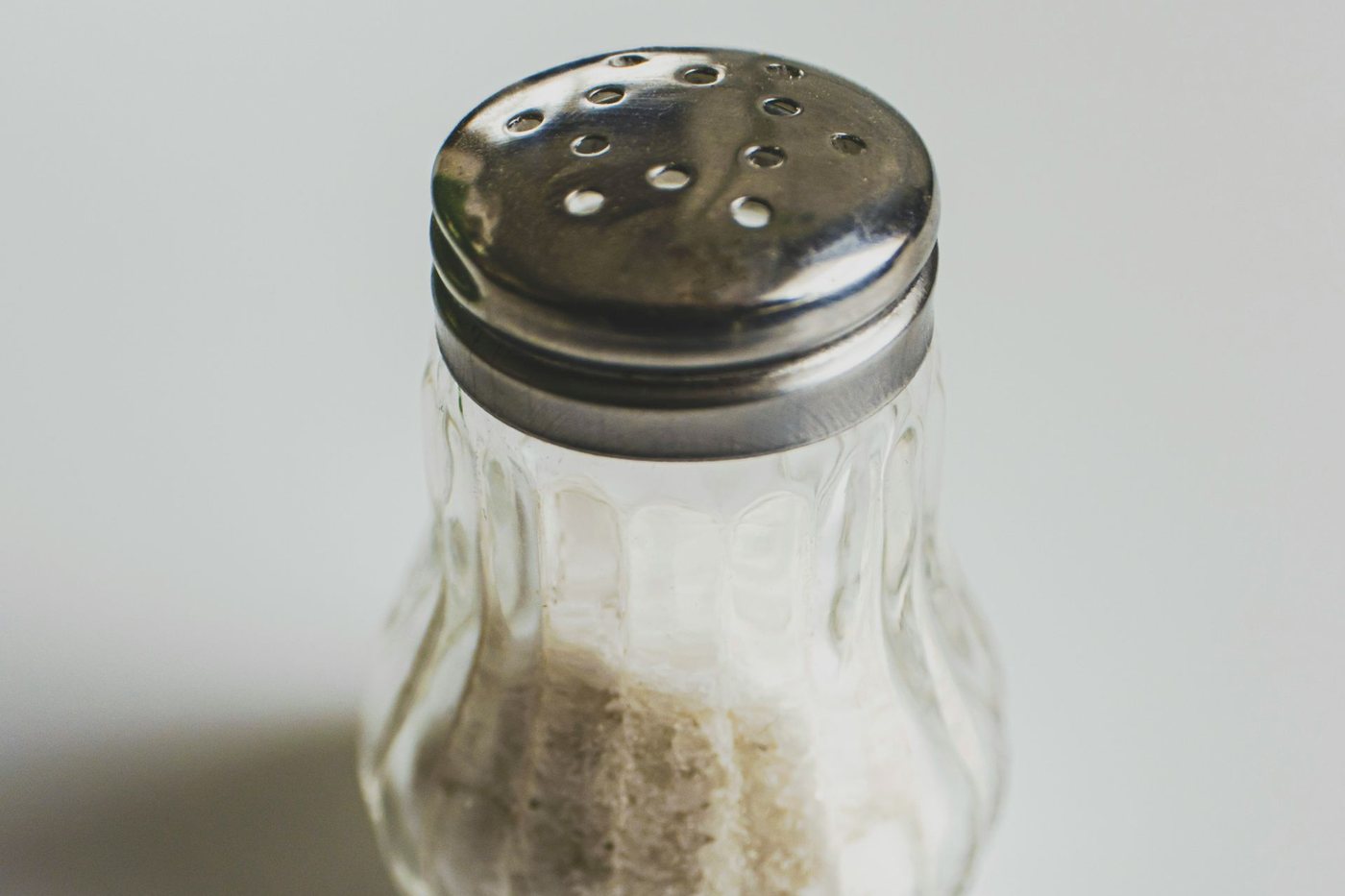
Added salt is sodium chloride — NaCl, CAS 7647-14-5 — added to food during manufacturing and processing. That definition matters, because this article is not about the salt in your shaker, and it is not about the sodium that occurs naturally in milk, meat or vegetables, or about other sodium-containing additives such as sodium benzoate or MSG. It is about the salt a manufacturer puts in — the salt that makes bread, cheese, ham, soup and pizza taste the way they do, and that supplies most of the sodium most of us eat.
The chemistry is simple, and it is the source of most of the confusion on labels. Salt is about 40% sodium and 60% chloride by weight. One gram of salt contains about 400 mg of sodium, and the conversion the EU writes into law is salt = sodium × 2.5 (the exact figure is 2.54). One teaspoon of table salt contains about 2,400 mg of sodium. So when the WHO limit is "less than 2,000 mg of sodium a day", that is the same as "less than 5 g of salt a day" — and when a US label says a serving has 690 mg of sodium, that is about 1.7 g of salt. Keep that conversion in mind and the rest of this article reads cleanly; forget it and every number looks three times too small or too large.
Added salt is also the odd one out in this guide in a regulatory sense. Unlike most ingredients here, salt has no E number and no maximum level as an ingredient anywhere: no country caps how much salt a manufacturer may put in a general food. What regulators control instead is the words — what the number on the pack must say, what "low sodium" and "no salt added" are allowed to mean — plus voluntary reduction targets and, in two American cities, warnings on menus. The story of added salt is the contrast between the strictness of the words and the softness of the limits, and the regulators section below lays it out jurisdiction by jurisdiction.
Tip: "salt" and "sodium" are not synonyms on a label, and the law says so explicitly in the US: salt refers to sodium chloride. A product can be high in sodium without any salt being added — from sodium bicarbonate, sodium benzoate or other sodium compounds — and a product with "no salt added" can still contain substantial sodium. The label section at the end of this article shows how to read both numbers.
Why manufacturers use it
Salt is in almost everything processed because it does several jobs at once, cheaply and predictably — which is also why it is so hard to take out.
Flavour first. Salt makes food taste like food. It enhances other flavours, suppresses bitterness, and gives savoury depth to products that would otherwise taste flat — bread, cheese, cured meats, soups, sauces and snacks all lean on it. A low-salt version of the same product usually tastes noticeably different, which is why manufacturers reduce salt gradually rather than all at once: consumers notice a sudden cut and stop buying.
Preservation. Salt is one of the oldest preservatives there is. The US Food and Drug Administration's own entry for sodium chloride lists its technical effects as including anticaking, antimicrobial, flavouring, nutrient supplement and stabiliser/thickener uses. Salt draws water out of food and out of microbes, which is why cured meats, pickles and brined cheeses keep — and why cutting salt shortens shelf life unless something else takes over the preserving job.
Texture and structure. In bread, salt tightens the gluten network and controls how fast the yeast ferments; in processed meats it helps proteins bind water and hold together; in cheese it controls moisture and ripening. These are functional roles, not flavour choices, and they are the reason a "just use less" reformulation often needs a recipe change rather than a smaller scoop.
And as a carrier. Salt is also the vehicle for iodine: the WHO recommends that all salt consumed should be iodised, and Australia made iodised salt mandatory in bread in 2009. That creates a genuine tension with salt reduction — cut the salt and you can cut the iodine too — which the alternatives section returns to.
The practical consequence is that added salt is not a single-purpose additive you can swap out like a colour. It is flavour, preservation, texture and a public-health delivery system in one cheap ingredient, and every one of those jobs has to be replaced or accepted when the salt goes down. That is why regulators have mostly chosen targets and labelling rather than bans — and why the debate section is about whether that choice is working.

Where you will find it
Most of the sodium you eat was added before the food reached you. The US Food and Drug Administration estimates that more than 70% of dietary sodium comes from packaged and prepared foods, and two studies that tracked where sodium actually comes from put the same figure at 77% (Mattes & Donnelly, 1991) and 70.9% (Harnack et al., 2017) for food processed or prepared outside the home. Salt inherent in food supplied 11.6–14.2%, salt added at the table 4.9–6.2%, and salt added in home cooking 5.1–5.6%. The shaker on your table, in other words, is a small share of the total — the salt that matters most is the salt you never see added.
The US Centers for Disease Control and Prevention lists the top adult sources: deli meat sandwiches, soups, pizza, poultry, savoury snacks, pasta mixed dishes, breads, rolls and buns, cheese and meat mixed dishes. Bread deserves a special mention because it does not taste salty: a food can be a major sodium source without tasting of salt at all, which is why "I don't eat salty food" is a poor guide to how much sodium you actually eat. Cheese, breakfast cereals, sauces and ready meals work the same way — the salt is doing preservation and texture work, not shouting about itself.
Two cautions belong here. First, the 70–77% figure is a Western pattern, not a global one: in parts of Asia most sodium is added at home during cooking — over 80% in Guangxi, China, for example — so the "it's the manufacturers" framing does not travel everywhere. Second, the numbers above come from American studies; the pattern is similar in Australia and the UK, where average salt intakes are also far above the recommended limits, but the exact shares differ by country and by diet.
Related: Sodium benzoate — another sodium-containing additive, used as a preservative in soft drinks and sauces, which adds sodium without adding salt. And Added sugars — the parallel story of an ingredient added during manufacturing that dominates intake from processed food.
The concern: blood pressure
The blood-pressure evidence is the strongest part of the file on added salt — and it is the part that rests on randomised trials, not on observation alone.
The WHO-commissioned review. Aburto et al. (2013, BMJ), a systematic review and meta-analysis commissioned by the WHO, pooled 37 randomised trials measuring blood pressure in adults. Reduced sodium intake lowered resting systolic blood pressure by 3.39 mm Hg and diastolic by 1.54 mm Hg. When intake was below 2 g of sodium a day versus at or above 2 g, systolic pressure was 3.47 mm Hg lower. In children, reduced sodium lowered systolic pressure by 0.84 mm Hg. And the review found no significant adverse effect of lower sodium on blood lipids, catecholamine levels or kidney function in adults.
The longer-term trials. He, Li & MacGregor (2013, BMJ), a Cochrane review of 34 trials with 3,230 participants and modest salt reduction lasting at least four weeks, found a similar picture with a dose-response attached: a reduction of 4.4 g of salt a day lowered systolic pressure by 4.18 mm Hg and diastolic by 2.06 mm Hg. The effect was larger in people with high blood pressure (5.39 mm Hg systolic) than in people with normal pressure (2.42 mm Hg), and each 100 mmol reduction in daily urinary sodium — about 6 g of salt — was associated with a 5.8 mm Hg fall in systolic pressure.
Who feels it most. Mente et al. (2016, The Lancet), pooling four large studies, found each extra gram of sodium a day was associated with a 2.08 mm Hg higher systolic pressure in people with hypertension, versus 1.22 mm Hg in people without it. A 2025 umbrella review of 21 meta-analyses (Kong et al.) put the same relationship at 0.60 mm Hg of systolic pressure per extra gram of sodium a day. The pattern is consistent across every synthesis: sodium raises blood pressure, more in people whose pressure is already high, and the effect grows with the dose.
Fair framing: three to five millimetres of mercury is a modest change for one person — it is not the difference between health and disease for an individual. The public-health case rests on shifting the whole population's distribution: a few points lower across millions of people means far fewer strokes and heart attacks, which is exactly what the next section measures. That is also why the guidelines are population limits (less than 2,000–2,300 mg of sodium a day) rather than personal prescriptions.
The concern: heart disease and stroke
If blood pressure is the mechanism, heart disease and stroke are the outcomes that matter — and here the evidence is strong but thinner, because it rests mostly on watching people rather than on trials.
Stroke. Strazzullo et al. (2009, BMJ) pooled 13 prospective studies with 177,025 participants and more than 11,000 vascular events. People with higher salt intake had a 23% higher risk of stroke (relative risk 1.23), and a 14–17% higher risk of cardiovascular disease, for a difference of about 5 g of salt a day between the high- and low-intake groups. Aburto's WHO review found the same direction: higher sodium was associated with a higher risk of stroke (relative risk 1.24), stroke mortality (1.63) and coronary heart disease mortality (1.32).
Cardiovascular mortality. A 2025 umbrella review (Kong et al.) found high salt intake associated with higher cardiovascular disease (relative risk 1.13), stroke (odds ratio 1.34) and stroke mortality (1.40), while lower sodium intake was associated with lower cardiovascular mortality (0.83), stroke mortality (0.74) and all-cause mortality (0.88). But the umbrella review's own credibility grading rates most of the low-sodium outcomes as weak evidence — a caveat this article keeps, because it matters.
The death toll, as modelled. The WHO's fact sheet attributes an estimated 1.7 million deaths a year to consuming too much sodium (2023 figure). The toll is large because the exposure is nearly universal: the global mean intake is more than double the recommendation, so even a modest per-person risk adds up to a large number of deaths.
What has not been proven. There is no large randomised trial of sodium reduction alone with hard cardiovascular endpoints in a general population. The blood-pressure effect is proven by trials; the step from blood pressure to heart attacks and strokes rests on cohort studies — which can be confounded — plus the one large trial that exists, which tested salt substitutes rather than sodium reduction itself (see the alternatives section). That does not make the case weak: the blood-pressure mechanism is established, the cohort evidence is large and consistent, and the substitute trial points the same way. But the honest statement is that the hard-outcome evidence is observational, and the debate section gives the other side its hearing.
The concern: infants and young children
Infants are the exception to every rule in this article — and the place where the guidance is most unanimous and the evidence thinnest at the same time.
The guidance is unanimous. The WHO's 2023 complementary-feeding guideline says foods high in sugar, salt and trans fats should not be consumed by infants and young children aged 6–23 months — a strong recommendation, explicitly on low-certainty evidence. Europe's paediatric gastroenterology society (ESPGHAN, 2017) says plainly: "No sugar or salt should be added to complementary foods." The WHO's child sodium recommendation (for ages 2–15, adjusted down from the adult figure by energy requirements) explicitly does not cover the first two years of life. And the US National Academies set an adequate intake of just 110 mg of sodium a day for infants aged 0–6 months and 370 mg a day for 7–12 months — and set no upper limit at all under age one, because the evidence was judged insufficient to set one.
The regulation is the strongest evidence for the old concern. Australia and New Zealand are the only jurisdiction found that sets hard maximum sodium levels for ordinary infant foods: under Standard 2.9.2, food for infants must not contain more sodium than 350 mg per 100 g for rusks, 300 mg per 100 g for biscuits, and 100 mg per 100 g for other infant foods including flours, pasta, ready-to-eat foods and fruit-based foods — and no added salt at all in ready-to-eat fruit-based foods, fruit drink and vegetable juice. Infant formula sodium is tightly bounded everywhere: 20–60 mg per 100 kcal in Australia and New Zealand, and 25–60 mg per 100 kcal in the EU. Australia even regulates infant formula by potential renal solute load, with sodium in the equation — the regulatory mechanism that operationalises the kidney-load concern behind the old advice that babies' kidneys cannot handle salt.
But "kidney strain" is a rationale, not a measured outcome. Every guideline gives the same reason — infant kidneys are not fully developed and cannot process excess sodium — and the physiological rationale is real in newborns. But there is no randomised trial showing that a small amount of added salt in complementary foods harms healthy 6–12-month-olds, and no upper limit has been set for under-ones in the US precisely because the evidence was judged insufficient. The defensible line is that the guidance is unanimous and precautionary, the mechanism is plausible, and the measured harm has not been demonstrated. Do not present "kidney strain" as something that has been measured in babies eating salty food — it has not.
The taste-preference question is real, and it is correlational. Stein, Cowart & Beauchamp (2012, American Journal of Clinical Nutrition) followed 61 infants, testing their response to salty water at 2 and 6 months. Only the infants who had already been introduced to starchy table foods preferred the salty solutions at 6 months (P=0.007), and they consumed 55% more salt during the preference test; at 36–48 months they were more likely to lick salt from the surface of foods (P=0.007). The authors' own caveat is the one this article repeats: the study is correlational, and an experimental study is needed to firmly prove causation — families who introduce table foods early may differ in other ways. The broader principle of early flavour learning is proven in humans — Mennella and Beauchamp showed that early experience shapes later flavour preferences for bitter, sour, savoury and volatile flavours such as carrot and garlic — but the salt-specific causal evidence does not exist. Say "linked to" or "associated with", never "causes".
The practical rule is simple and does not depend on resolving any of this: do not add salt to a baby's food or cooking water, do not use stock cubes or gravy, and avoid the salty adult foods — bacon, sausages, crisps, ready meals and takeaways — for babies and toddlers. The foods marketed for infants in Australia and New Zealand are already capped by law; elsewhere, the label is the only guardrail, and the label section below shows how to read it.
What regulators say
Every major authority permits added salt in food — but the rules are narrow, the numbers are specific, and the ingredient is controlled through words and targets rather than through a cap. There is no maximum level for salt as an ingredient in general food anywhere.
World Health Organization. For adults, less than 2,000 mg of sodium a day (less than 5 g of salt). The global mean intake in 2021 was 4,278 mg of sodium a day — more than double the recommendation. In 2013 member states adopted a target of a 30% relative reduction in mean population sodium intake, originally by 2025 and extended to 2030; the world is off-track. The WHO's 2023 global report found only 5% of Member States are protected by mandatory and comprehensive sodium-reduction policies, 73% lack the full range of implementation, and only nine countries have a comprehensive package — while implementing cost-effective sodium policies could save an estimated 7 million lives by 2030. The WHO also notes that mandatory policies are more effective than voluntary ones.
United States — the label is the law. Salt is named in 21 CFR 182.1(a) as generally recognised as safe for its intended use, and there is no federal maximum level for salt as an ingredient. Control runs through the Nutrition Facts label: sodium is a mandatory declared nutrient, with a Daily Value of 2,300 mg (21 CFR 101.9, verified against the eCFR text for this article), and the FDA's rule of thumb is that 5% of the Daily Value or less per serving is low and 20% or more is high. The FDA's voluntary sodium-reduction goals, finalised in October 2021, aim to cut average intake from about 3,400 mg a day to 3,000 mg a day across 16 food categories and 163 subcategories over two and a half years; a preliminary assessment of 2010–2022 data found about 40% of categories had met or were within 10% of the Phase I targets, and 100% of toddler and baby food categories had reduced sodium. Phase II draft guidance (August 2024) would take the average to 2,750 mg a day — about 20% below the pre-2021 intake — but it is a draft, not final, and the three-year clock does not start until a final guidance issues. The FDA's updated "healthy" claim (final rule December 2024, compliance 25 February 2028) caps sodium at 10% of the Daily Value — 230 mg per reference amount — for individual foods, 15% (345 mg) for mixed products and 30% (690 mg) for meals. A proposed front-of-pack "Nutrition Info box" remains a proposal: do not treat it as law.
United States — the claim tiers. Under 21 CFR 101.61, "sodium free" means less than 5 mg of sodium per reference amount; "very low sodium" means 35 mg or less; "low sodium" means 140 mg or less per reference amount; and "reduced sodium" means at least 25% less sodium than a reference food, with the comparison stated. "Salt free" may be used only if the food is sodium free. And "no salt added", "unsalted" and "without added salt" may be used only if no salt was added during processing and the food it resembles is normally processed with salt — and if the food is not sodium-free, the label must state "This is not a sodium free food". The trap is the missing piece: the US rule sets no sodium cap for "no salt added", so a no-salt-added food can still contain substantial natural sodium. "Lightly salted" means 50% less sodium than is normally added to the reference food.
United States — the two cities that went further. No US state sodium ban was found in this research; the only mandatory sodium warnings verified in the US are two city rules. New York City's sodium warning rule (Health Code §81.49, adopted 9 September 2015, effective 1 December 2015) requires chain restaurants with 15 or more locations to put a salt-shaker icon next to any item or combination meal containing 2,300 mg or more of sodium, with a warning that high sodium intake can increase blood pressure and risk of heart disease and stroke; fines of $200 applied from 1 March 2016, and the restaurant industry's challenge was rejected on appeal in February 2017. Philadelphia followed in 2019 with the same 2,300 mg threshold for chains, fines of up to $500 — the second US city to require sodium warnings, after New York.
European Union — "salt", not "sodium". Regulation (EU) No 1169/2011 requires the nutrition declaration to state "salt" in grams per 100 g, defined as salt = sodium × 2.5, because consumers understand "salt" better than "sodium" — and the figure covers total sodium, natural and added. The claim tiers in Regulation (EC) No 1924/2006 are: "low sodium/salt" at no more than 0.12 g of sodium (about 0.3 g of salt) per 100 g; "very low sodium/salt" at 0.04 g; "sodium-free or salt-free" at 0.005 g; and "no added sodium/salt" only where nothing was added and the product contains no more than 0.12 g of sodium per 100 g — so the EU "no added salt" claim is also capped at the low-sodium level, stricter than the US rule. There is no EU-wide maximum salt level for general foods or bread; limits exist only in member-state law, notably for bread. Infant formula sodium is set at 25–60 mg per 100 kcal under Delegated Regulation (EU) 2016/127.
Australia and New Zealand — sodium in milligrams, per 100 g. The nutrition information panel must declare sodium in milligrams per serving and per 100 g or 100 mL (Standard 1.2.8) — there is no % Daily Value column, so the per-100-g column is the comparison tool. The claim tiers (Schedule 4) are: "low" salt or sodium at no more than 120 mg of sodium per 100 g for solids — numerically the same salt level as the EU's low claim, expressed differently; "reduced" or "light" at at least 25% less sodium than the reference food; and "no added" where the food contains no added sodium compound at all, including no added salt — broader than the US rule, which covers salt only. A general-level health claim — a diet low in salt or sodium reduces blood pressure — is allowed only for foods meeting the low-sodium conditions. Australia also made iodised salt mandatory in bread in 2009 (9 October 2009 in Australia, 27 September 2009 in New Zealand; organic bread exempt), and the proportion of children aged 2–3 with inadequate iodine intakes fell from 9% to 1% afterwards.
Australia — the voluntary targets that did not move the number. The Healthy Food Partnership's reformulation programme is voluntary: Wave 1 began in July 2020 with sodium targets for 27 food categories, Wave 2 in July 2021 added 5 more, with targets ranging from 270 mg per 100 g for plain corn and rice cakes to 1,270 mg per 100 g for processed cheese. A preprint evaluation published in November 2026 — not yet peer-reviewed — found compliance rose from 51.1% to 59.1% over four years, but the mean sodium content of targeted foods rose by 6.2 mg per 100 g (1.3%): the targets, on that provisional reading, failed to reduce the overall sodium content of the foods they covered. Treat the preprint as provisional; the direction of the finding is the point, not the decimal.
Potassium chloride, the substitute. The salt substitute most of this article's alternatives section discusses — potassium chloride — is affirmed as generally recognised as safe in the US under 21 CFR 184.1622, with no limitation other than current good manufacturing practice (verified against the eCFR text for this article). The WHO's 2025 guideline on lower-sodium salt substitutes gives a conditional recommendation to replace table salt with potassium-containing substitutes — for adults in the general population only, excluding children, pregnant women, people with kidney impairment and anyone whose potassium excretion may be compromised, on low-certainty evidence. The same guideline warns that just under half of the substitutes available globally are iodised.
The debate
The case for the current limits
The limits we have are built on the strongest evidence in nutrition: dozens of randomised trials showing blood pressure falls when sodium falls, with no adverse effects on blood lipids, catecholamines or kidney function in the WHO-commissioned review, and a dose-response that runs smoothly across the range with no floor. The WHO, the US National Academies and the FDA all still recommend less than 2,000–2,300 mg of sodium a day, and the voluntary system is moving some categories — the FDA's preliminary assessment found about 40% of food categories at or within 10% of the Phase I targets, and every toddler and baby food category reduced sodium. The J-shaped cohort studies are the weakest form of evidence making the strongest claim: spot-urine estimates, sicker people eating less salt, and a low-intake band that cannot tell 2.0 g from 2.9 g a day. Nobody has run the trial that would settle it, and until somebody does, the trial evidence we have points one way.
The case that the limits are too lax — and the J-curve
The limits are not being met anywhere, and the system designed to meet them is not working: average intakes run about double the WHO figure in every country measured, only 5% of WHO Member States are protected by mandatory policies, the FDA's own Phase I goal of 3,000 mg a day sits above its 2,300 mg a day limit, and Australia's voluntary targets left the average sodium content of targeted foods higher than when they started. Voluntary is a choice, and the WHO's own report says mandatory policies work better. And the J-curve cannot be waved away: two studies covering more than 230,000 people found higher risk below about 3 g of sodium a day as well as above 7 g, with the lowest risk at 3–6 g — far above any guideline. The honest position is that the low end is contested, not that it is refuted, and that the guidelines rest on blood-pressure trials while the hard-outcome evidence at very low intakes is genuinely thin.
Who should be careful
Added salt is not an ingredient most people need to hunt down and eliminate. The people who should think about it are specific — and the reasons are narrower than the headlines suggest.
- People with high blood pressure. The blood-pressure effect of sodium is larger in people whose pressure is already high — about 5.4 mm Hg systolic per 4.4 g of salt a day in trials, versus 2.4 mm Hg in people with normal pressure — and the pooled cohort evidence finds the high-intake risk concentrated in hypertensives. If your pressure is high, sodium is one of the few dietary levers with trial evidence behind it.
- Parents of infants and young children. No added salt in complementary foods, no salt in a baby's cooking water, and the salty adult foods kept off a baby's plate — the guidance is unanimous, and in Australia and New Zealand the infant-food maxima are law. The taste-preference evidence is correlational, but the precaution costs nothing.
- People considering salt substitutes. Potassium-enriched substitutes are not for everyone: the WHO excludes children, pregnant women, people with kidney impairment and anyone taking potassium-sparing diuretics or potassium supplements, because the substitute trades a sodium problem for a potassium one. If any of those apply to you, ask a doctor before switching — and check the substitute is iodised.
- People whose doctors have told them not to restrict sodium. The WHO sodium guideline itself excludes people with illnesses or drug therapy that may lead to low blood sodium or acute build-up of body water, or who need physician-supervised diets — heart failure and type 1 diabetes are the examples it names. Low blood sodium is a clinical condition linked to illness, medicines and excess water intake, not something healthy adults cause by eating less salt — and no guideline recommends that healthy adults eat more salt to avoid it. If you are in one of the excluded groups, sodium is a medical question, not a label-reading one.
- People who sweat heavily. Endurance athletes and outdoor workers in the heat lose sodium in sweat and need more than the general limit. No single figure applies, and this article does not set one — the point is only that the population limit is not a personal prescription for everyone in every circumstance.
For everyone else, the numbers are worth stating plainly: average intakes run about double the limits, more than 70% of the sodium comes from food you did not salt yourself, and the single biggest lever is eating less processed and restaurant food — not shaking the shaker less, though that helps too.
How to spot it on a label
Added salt is one of the harder ingredients to track on a label — not because it is hidden, but because three jurisdictions report the same number in three different languages.
- Salt versus sodium — do the conversion. Salt in grams equals sodium in grams × 2.5, and 1 g of salt is about 400 mg of sodium. A label that says 0.4 g of sodium per 100 g is a label that says 1.0 g of salt per 100 g in the EU — and 400 mg of sodium per 100 g in the US and Australia. One teaspoon of table salt is about 2,400 mg of sodium. If you remember one conversion, remember × 2.5.
- United States: sodium in milligrams per serving, with a % Daily Value. The Daily Value is 2,300 mg, and the FDA's rule of thumb is that 5% of the Daily Value or less per serving is low and 20% or more is high. Remember the serving size: the US "low sodium" limit of 140 mg is per serving (per reference amount), not per 100 g, so a small-serving product can be "low sodium" at a higher per-100-g concentration than a European or Australian "low" product.
- European Union: "salt" in grams per 100 g. The nutrition declaration says "salt", not sodium. The claim tiers are low at 0.12 g of sodium (about 0.3 g of salt) per 100 g, very low at 0.04 g, and sodium-free at 0.005 g — and "no added sodium/salt" is capped at the low level as well.
- Australia and New Zealand: sodium in milligrams per serving and per 100 g. There is no % Daily Value column, so use the per-100-g column to compare products. "Low" means 120 mg of sodium or less per 100 g for solids — the same salt level as the EU's low claim, expressed in sodium rather than salt. "Reduced" means at least 25% less than the reference food, and "no added" means no added sodium compound at all.
| Claim | United States | European Union | Australia / NZ |
|---|---|---|---|
| Free | "Sodium free": <5 mg sodium per reference amount | "Sodium/salt-free": ≤0.005 g sodium per 100 g | No "free" claim tier verified |
| Very low | ≤35 mg sodium per reference amount | ≤0.04 g sodium per 100 g | No "very low" claim tier verified |
| Low | ≤140 mg sodium per reference amount (per serving, not per 100 g) | ≤0.12 g sodium (≈0.3 g salt) per 100 g | ≤120 mg sodium per 100 g (solids) |
| Reduced | ≥25% less sodium than the reference food | Comparative claim (percentage not re-verified for this article) | ≥25% less sodium than the reference food |
| No added | No salt added in processing; no sodium cap — label must say "This is not a sodium free food" if it is not sodium-free | No added sodium/salt and ≤0.12 g sodium per 100 g | No added sodium compound at all, including no added salt |
The "no salt added" trap is the single most useful thing in this section. In the US, a "no salt added" product can lawfully fail the European and Australian tests — it can contain substantial natural sodium, with only the "not a sodium free food" disclosure to warn you. In the EU the same words guarantee the low-sodium level. In Australia and New Zealand they guarantee more: no added sodium compound of any kind. The same three words mean three different things, and the number on the back of the pack is the only way to tell which one you are holding.
What the label will not tell you. It will not tell you how much of your daily limit the product represents in Australia (no % Daily Value column), it will not tell you how much salt was added versus how much was already in the ingredients, and in the US it will not tell you whether the product was made with iodised salt. For the total, the per-100-g figure is your friend: compare products on that column, not on the serving, because servings are set by the manufacturer.
Alternatives: what replaces it
There is no drop-in "healthy salt" that does everything sodium chloride does with no open questions — the replacements differ in who they suit, not in a proven safety ranking.
- Potassium-enriched salt substitutes — the option with trial evidence. The largest trial, SSaSS (Neal et al., 2021, New England Journal of Medicine), randomised 600 villages in rural China — 20,995 people with a history of stroke or aged 60 and over with poorly controlled blood pressure — to a substitute of 75% sodium chloride and 25% potassium chloride or to regular salt, for an average of 4.74 years. Stroke fell by 14% (rate ratio 0.86), major cardiovascular events by 13% (0.87) and death from any cause by 12% (0.88), with no significant increase in serious events attributed to high blood potassium (3.35 versus 3.30 per 1,000 person-years). A meta-analysis of 21 trials with 31,949 participants (Yin et al., 2022, Heart) found substitutes lowered systolic pressure by 4.61 mm Hg and diastolic by 1.61 mm Hg, with total mortality 0.89, cardiovascular mortality 0.87 and cardiovascular events 0.89 — and a Cochrane review of 26 trials found systolic pressure 4.76 mm Hg lower and diastolic 2.43 mm Hg lower, with blood potassium up by a mean of 0.12 mmol/L and the hyperkalaemia data unreliable. The WHO's 2025 guideline gives a conditional recommendation to replace table salt with potassium-containing substitutes — for adults in the general population, excluding children, pregnant women and people with kidney impairment or compromised potassium excretion, and for discretionary salt only, not for salt already in packaged or restaurant food.
- The limits of that evidence. SSaSS was one trial in rural China, where most salt is added at home during cooking, in high-risk participants, open-label, with the substitute provided free. The hard-outcome case for substitutes rests essentially on that one trial — and the authors of the meta-analyses say so. Do not present substitutes as proven to prevent strokes outside high-discretionary-salt, high-risk settings. And check the iodine: just under half of the lower-sodium substitutes available globally are iodised, so switching to a non-iodised substitute can cut iodine intake — the WHO recommends that all salt consumed should be iodised, and Australia made iodised salt mandatory in bread for exactly that reason.
- Herbs, spices and acid. Garlic, herbs, spices, chilli, citrus and vinegar add flavour without sodium, and they are the practical answer for home cooking — where, in Western diets, only about 5% of sodium comes from the cooking pot anyway. The bigger lever at home is cooking from scratch more often: the salt you add yourself is a small share, but the salt in the ready meal you replace is not.
- More potassium from food. The WHO suggests a potassium intake of at least 3,510 mg a day (90 mmol) from food for adults — a conditional recommendation — and higher potassium intake reduced blood pressure in adults. Fruit, vegetables, beans and unsalted nuts are the ordinary sources, and the PURE study found higher potassium excretion associated with lower risk of death and major cardiovascular events. Potassium from food is not the same as potassium from a substitute, and the two should not be confused.
- For the food itself, not the salt: the simplest reduction is eating less of the processed and restaurant food that carries most of the sodium. Whole foods — fresh vegetables, fruit, grains, unprocessed meat and fish — do not need salt added, and that is the only swap with no open questions attached. The trade-off that runs through this whole article is the one the regulators state: salt keeps food tasty, safe and affordable at a fraction of a percent of the product, within limits that typical intakes sit roughly double above, while the harms on file are a proven blood-pressure effect, a consistent cohort link to stroke and heart disease, and an infant rule that is precautionary rather than proven. The sensible response is the general rule — less processed food overall, and no need to hunt for a "salt-free" version of the same snack.
Frequently asked questions
How much salt should I eat a day?
The WHO recommends less than 2,000 mg of sodium a day for adults — less than 5 g of salt, or just under a teaspoon. The US limit is less than 2,300 mg of sodium a day, about 5¾ g of salt. Average intakes run about double the WHO figure: the global mean was 4,278 mg of sodium a day in 2021, and Americans average more than 3,300 mg a day. For children aged 2–15 the WHO figure is adjusted downward by energy requirements; the recommendation does not cover the first two years of life, which have their own rule — no added salt.
Is salt the same as sodium?
No. Salt is sodium chloride, and it is about 40% sodium by weight. To convert, multiply sodium by 2.5 to get salt: 400 mg of sodium is about 1 g of salt, and one teaspoon of table salt contains about 2,400 mg of sodium. The EU declares 'salt' on labels (sodium × 2.5); the US and Australia declare 'sodium' in milligrams. A product can also be high in sodium without any salt being added, from other sodium compounds such as sodium bicarbonate or sodium benzoate.
Does "no salt added" mean low sodium?
Not necessarily — it depends on the country. In the US the claim only means no salt was added during processing, and there is no sodium cap: the label must say 'This is not a sodium free food' if the product is not sodium-free. In the EU, 'no added sodium/salt' also requires the product to contain no more than 0.12 g of sodium per 100 g, which is the low-sodium level. In Australia and New Zealand it means no added sodium compound at all, including no added salt. Check the number on the back of the pack either way.
Should I add salt to my baby's food?
No. The WHO and Europe's paediatric gastroenterology society both say no sugar or salt should be added to complementary foods, and the WHO's complementary-feeding guideline makes it a strong recommendation. In Australia and New Zealand, infant foods have hard legal maxima — 350 mg of sodium per 100 g for rusks, 300 mg for biscuits, 100 mg for other infant foods — and added salt is banned outright in infant fruit-based foods, fruit drink and vegetable juice. One prospective study found babies introduced to starchy table foods early were more likely to prefer salty tastes, but that study was correlational, not a trial — it shows a link, not a cause.
Are salt substitutes safe?
For most adults, the WHO gives a conditional recommendation to replace table salt with potassium-containing substitutes — conditional because the evidence certainty is low and the recommendation excludes children, pregnant women, people with kidney impairment and anyone whose potassium excretion may be compromised. The biggest trial (SSaSS, 20,995 people, 75% sodium chloride / 25% potassium chloride) cut strokes by 14% and deaths by 12% with no significant increase in serious high-potassium events, but it was one trial in rural China in high-risk people, so the result does not automatically generalise. Check that any substitute is iodised — just under half of them globally are not.
Is too little salt dangerous?
This is the live debate, and it is genuinely unresolved. Two very large cohort studies (PURE, 2014, and a pooled analysis of four cohorts, 2016) found higher risk of death and cardiovascular events not only above about 7 g of sodium a day but also below about 3 g a day — a J-shaped curve, with the lowest risk between 3 and 6 g a day, far above any guideline. The other side points out that the low-intake group was estimated from single spot-urine samples (a method critics call unreliable and biased), that the people eating the least salt were older and sicker to begin with, and that the 'below 3 g' band cannot distinguish 2.0 g from 2.9 g a day. Randomised trials, meanwhile, show blood pressure falls as sodium falls with no adverse effects on blood lipids or kidney function. No trial has tested hard outcomes at intakes below 2 g a day, and the WHO, the US National Academies and the FDA all still recommend less than 2,000–2,300 mg a day.
Checked against the WHO salt reduction fact sheet (2026), FDA 21 CFR 101.9 and 101.61, Regulation (EU) No 1169/2011, FSANZ Standard 2.9.2, Aburto et al. 2013 (BMJ) and Neal et al. 2021 (NEJM) · Last updated 2026-11-17 · How we assess ingredients
Sources (29)
- World Health Organization — Salt reduction fact sheet (published 11 May 2026): global mean intake 4,278 mg sodium/day (11 g salt) in 2021, more than double the recommendation of less than 2,000 mg/day sodium (less than 5 g/day salt); an estimated 1.7 million deaths each year associated with consuming too much sodium in 2023; children 2–15 adjusted down by energy requirements, 0–24 months not covered; all salt consumed should be iodized; US$1 invested in sodium reduction returns at least US$12
- World Health Organization — Global report on sodium intake reduction, 2023 (news release, 9 Mar 2023): the world is off-track to achieve a 30% reduction by 2025; only 5% of Member States protected by mandatory and comprehensive policies and 73% lack full implementation; only nine countries have a comprehensive package; implementing cost-effective policies could save an estimated 7 million lives globally by 2030; mandatory policies more effective than voluntary ones
- World Health Organization — Use of lower-sodium salt substitutes: WHO guideline (Geneva, 2025; NCBI Bookshelf): conditional recommendation to replace table salt with potassium-containing substitutes, for adults in general populations only, excluding children, pregnant women and people with kidney impairment or compromised potassium excretion; evidence certainty low; based on 26 RCTs; applies to discretionary salt only; just under half of lower-sodium substitutes globally are iodized
- World Health Organization — Guideline: Sodium intake for adults and children (Geneva, 2012): strong recommendation to reduce sodium to less than 2 g/day (5 g/day salt) in adults; children's intake adjusted downward by energy requirements; excludes individuals with illnesses or drug therapy that may lead to hyponatraemia or acute build-up of body water, or who require physician-supervised diets (e.g. heart failure, type 1 diabetes); salt reduction and salt iodization are compatible
- US Food and Drug Administration — 21 CFR 101.9, Nutrition labeling of food (eCFR, text verified directly for this article, 2026-11-17): sodium is a mandatory declared nutrient in mg per serving with % Daily Value; Daily Value for sodium 2,300 mg; FDA's rule of thumb is 5% DV or less per serving is low and 20% DV or more is high; the 2016 label modernisation rule set the 2,300 mg DV, compliance 1 Jan 2020 / 1 Jan 2021
- US Food and Drug Administration — Voluntary Sodium Reduction Goals (final guidance, October 2021) and Edition 2 draft guidance (15 August 2024), via Covington summaries: Phase I goal to reduce average intake from over 3,400 mg/day to 3,000 mg/day across 16 categories and 163 subcategories, 2.5-year targets to April 2024; preliminary assessment (2010–2022 data) found about 40% of categories had achieved or were within 10% of Phase I targets and 100% of toddler and baby food categories reduced sodium; Phase II draft goal 2,750 mg/day, about 20% below pre-Phase I intake, three-year targets once finalised — draft, not final
- US Food and Drug Administration — Food Labeling: Nutrient Content Claims; Definition of Term 'Healthy', final rule (announced 19 December 2024; compliance 25 February 2028), via Cooley: individual foods sodium no more than 10% DV (230 mg per reference amount); mixed products 15% DV (345 mg); meals 30% DV (690 mg); a food must also contain a minimum food-group equivalent and meet added-sugars and saturated-fat limits
- US Food and Drug Administration — 21 CFR 101.61, Nutrient content claims (FindLaw reproduction of the CFR text; 'lightly salted' per the FDA Food Labeling Guide, Appendix A): 'sodium free' less than 5 mg per reference amount; 'very low sodium' 35 mg or less; 'low sodium' 140 mg or less; 'reduced sodium' at least 25% less than a reference food; 'salt' is not synonymous with 'sodium'; 'salt free' only if 'sodium free'; 'no salt added' / 'unsalted' only if no salt added in processing and the food it replaces is normally salted, with a 'This is not a sodium free food' disclosure where applicable and no sodium cap; 'lightly salted' is 50% less sodium than normally added
- US Food and Drug Administration — 21 CFR 182.1(a) (eCFR, text verified directly for this article, 2026-11-17): salt named among the common food ingredients the Commissioner regards as generally recognized as safe for their intended use; there is no federal maximum level for salt as an ingredient. The FDA Substances Added to Food entry for sodium chloride (CAS 7647-14-5) lists its technical effects as anticaking, antimicrobial, flavouring agent, nutrient supplement and stabiliser/thickener
- US Food and Drug Administration — 21 CFR 184.1622, Potassium chloride (eCFR, text verified directly for this article, 2026-11-17): potassium chloride (CAS 7447-40-7) affirmed as generally recognized as safe as a direct human food ingredient, used in food with no limitation other than current good manufacturing practice
- European Union — Regulation (EU) No 1169/2011 on the provision of food information to consumers (EUR-Lex): Annex I definition 11, 'salt' means the salt equivalent content calculated using the formula salt = sodium × 2,5; Article 30 requires the mandatory nutrition declaration to state salt per 100 g/ml; the salt figure is derived from total sodium. Claim tiers are in Regulation (EC) No 1924/2006, Annex: 'low sodium/salt' no more than 0.12 g sodium per 100 g/ml; 'very low sodium/salt' 0.04 g; 'sodium-free or salt-free' 0.005 g; 'no added sodium/salt' requires no added sodium/salt and no more than 0.12 g sodium per 100 g. Infant formula sodium 25–60 mg per 100 kcal under Commission Delegated Regulation (EU) 2016/127, Annex I §10. There is no EU-wide maximum salt level for general foods or bread
- Food Standards Australia New Zealand — Standard 1.2.8 (Nutrition Information Panel: sodium declared in mg per serving and per 100 g/ml, one of seven mandatory items, no % Daily Value column) and Standard 1.2.7 with Schedule 4 (nutrition content claims: 'low' salt or sodium no more than 120 mg/100 g for solids; 'reduced' or 'light' at least 25% less sodium than the reference food; 'no added' means no added sodium compound including no added salt; general-level health claim that a diet low in salt or sodium reduces blood pressure, only for foods meeting the low-sodium conditions)
- Food Standards Australia New Zealand — Standard 2.9.2 (food for infants) and Schedule 29 (infant formula products): food for infants must not contain more sodium than 350 mg/100 g for rusks, 300 mg/100 g for biscuits and 100 mg/100 g for other infant foods including flours, pasta, ready-to-eat foods and fruit-based foods, with no added salt in ready-to-eat fruit-based foods, fruit drink and vegetable juice; infant formula sodium minimum 4.8 mg / maximum 14 mg per 100 kJ (20–60 mg/100 kcal); potential renal solute load of infant formula calculated using sodium among other electrolytes
- Food Standards Australia New Zealand — Iodine fortification: mandatory iodine fortification implemented in 2009 through Standard 2.1.1, requiring iodised salt for making all breads except organic bread (New Zealand from 27 September 2009; Australia from 9 October 2009); the proportion of children aged 2–3 years with inadequate iodine intakes decreased from 9% to 1% after mandatory fortification
- George Institute / UNSW — Changes in compliance and sodium content of packaged foods after four years of Australia's voluntary sodium reformulation targets (Research Square preprint, posted 6 Nov 2026, not yet peer-reviewed): the Healthy Food Partnership (voluntary; Wave 1 July 2020, 27 sodium categories; Wave 2 July 2021, 5 more; targets 270–1,270 mg/100 g) saw overall compliance rise from 51.1% to 59.1% over four years, while the mean sodium content of targeted foods increased by 6.2 mg/100 g (1.3%); the targets 'achieved only modest gains in compliance and failed to reduce the overall sodium content of targeted foods'
- New York City sodium warning rule (24 RCNY 81.49) and Philadelphia sodium warning rule (Philadelphia Code §6-310): New York adopted 9 September 2015, effective 1 December 2015 — salt-shaker icon next to any item or combination meal containing 2,300 mg or more of sodium in chain restaurants with 15 or more locations, $200 fines from 1 March 2016; the National Restaurant Association's challenge was rejected by the Appellate Division, First Department, 10 February 2017 (148 AD3d 169). Philadelphia (Bill No. 180001-A, passed 21 June 2018, enforcement from 14 September 2019) uses the same 2,300 mg threshold with fines up to $500 and was the second US city to require sodium warnings, after New York City
- Aburto NJ, Ziolkovska A, Hooper L, Elliott P, Cappuccio FP, Meerpohl JJ. Effect of lower sodium intake on health: systematic review and meta-analyses. BMJ. 2013;346:f1326: 37 RCTs measuring blood pressure; reduced sodium lowered systolic BP by 3.39 mm Hg and diastolic by 1.54 mm Hg; below 2 g/day versus at or above 2 g/day, systolic BP 3.47 mm Hg lower; in children systolic BP 0.84 mm Hg lower; no significant adverse effect on blood lipids, catecholamine levels or renal function; higher sodium associated with stroke RR 1.24, stroke mortality 1.63 and coronary heart disease mortality 1.32
- He FJ, Li J, MacGregor GA. Effect of longer term modest salt reduction on blood pressure: Cochrane systematic review and meta-analysis of randomised trials. BMJ. 2013;346:f1325: 34 trials, 3,230 participants, modest salt reduction for at least 4 weeks; a 4.4 g/day reduction in salt lowered systolic BP by 4.18 mm Hg and diastolic by 2.06 mm Hg; hypertensives 5.39 mm Hg systolic, normotensives 2.42 mm Hg; dose-response of 5.8 mm Hg systolic per 100 mmol (6 g/day salt) reduction in urinary sodium
- Strazzullo P, D'Elia L, Kandala N-B, Cappuccio FP. Salt intake, stroke, and cardiovascular disease: meta-analysis of prospective studies. BMJ. 2009;339:b4567: 13 prospective studies, 177,025 participants, more than 11,000 vascular events; higher salt intake associated with stroke RR 1.23 and cardiovascular disease RR 1.14 (1.17 after excluding one outlying study), for a difference of about 5 g/day in habitual salt intake
- O'Donnell M, Mente A, Rangarajan S, et al.; PURE Investigators. Urinary sodium and potassium excretion, mortality, and cardiovascular events. N Engl J Med. 2014;371(7):612–623, and Mente A, O'Donnell M, Rangarajan S, et al. Associations of urinary sodium excretion with cardiovascular events in individuals with and without hypertension: a pooled analysis of data from four studies. Lancet. 2016;388(10043):465–475: PURE (101,945 persons in 17 countries, spot urine with Kawasaki formula) found higher risk below 3 g/day sodium excretion (OR 1.27) and above 7 g/day (OR 1.15) versus 4.00–5.99 g/day, with the lowest risk at 3–6 g/day; the pooled analysis (133,118 individuals, 49 countries) found the same J-shape in hypertensives (below 3 g/day HR 1.34; 7 g/day or more HR 1.23) and no association at high intake in normotensives (HR 0.90) but higher risk at low intake (HR 1.26)
- Kong F, Liu Q, Zhou Q, Xiao P, Bai Y, Wu T, Xia L. Dietary salt intake and cardiovascular outcomes: an umbrella review of meta-analyses and dose-response evidence. Ann Med. 2025;57(1):2582065: 21 meta-analyses, 91 outcomes; high salt associated with cardiovascular disease RR 1.13, stroke OR 1.34 and stroke mortality OR 1.40; low sodium associated with cardiovascular mortality RR 0.83, stroke mortality 0.74 and all-cause mortality 0.88; each 1 g/day increase in sodium raised systolic BP by 0.60 mm Hg and cardiovascular and stroke risks by 4% and 6%; the review's own credibility grading rates most low-sodium outcomes as weak (Class IV) evidence
- Neal B, Wu Y, Feng X, et al. Effect of salt substitution on cardiovascular events and death. N Engl J Med. 2021;385(12):1067–1077 (SSaSS), and Yin X, Rodgers A, Perkovic A, et al. Effects of salt substitutes on clinical outcomes: a systematic review and meta-analysis. Heart. 2022;108(20):1608–1615: SSaSS (600 villages in rural China, 20,995 persons, mean follow-up 4.74 years; substitute 75% sodium chloride / 25% potassium chloride) — stroke rate ratio 0.86, major cardiovascular events 0.87, death from any cause 0.88; serious adverse events attributed to clinical hyperkalaemia 3.35 vs 3.30 per 1,000 person-years (rate ratio 1.04, not significant). Yin (21 trials, 31,949 participants) — systolic BP 4.61 mm Hg lower, diastolic 1.61 mm Hg lower; total mortality RR 0.89, cardiovascular mortality 0.87, cardiovascular events 0.89. A Cochrane review of 26 RCTs (Brand et al., 2022, as reported in the WHO 2025 guideline) found systolic BP 4.76 mm Hg lower and diastolic 2.43 mm Hg lower, with blood potassium up by a mean of 0.12 mmol/L and hyperkalaemia data unreliable
- National Academies of Sciences, Engineering, and Medicine. Dietary Reference Intakes for Sodium and Potassium. Washington, DC: The National Academies Press; 2019: sodium Adequate Intake 110 mg/day for infants 0–6 months and 370 mg/day for infants 7–12 months, 1,500 mg/day for ages 14 and older; Chronic Disease Risk Reduction Intake for ages 14 and older is to reduce sodium intakes if above 2,300 mg/day; no Tolerable Upper Intake Level was set for sodium or potassium
- US Centers for Disease Control and Prevention — About Sodium and Health (page dated 29 June 2026): Americans consume more than 3,300 mg of sodium per day on average (NHANES 2021–2023), above the federal recommendation of less than 2,300 mg a day; most sodium comes from processed and restaurant foods; top adult sources are deli meat sandwiches, soups, pizza, poultry, savoury snacks, pasta mixed dishes, breads/rolls/buns, cheese and meat mixed dishes; salt is sodium chloride, 40% sodium and 60% chloride, and one teaspoon of table salt contains about 2,400 mg of sodium
- Mattes RD, Donnelly D. Relative contributions of dietary sodium sources. J Am Coll Nutr. 1991;10(4):383–393, and Harnack L, et al. Sources of sodium in US adults from 3 geographic regions. Circulation. 2017;135(19):1775–1783: Mattes & Donnelly (62 adults) — sodium added during processing contributed 77% of total intake, inherent sodium 11.6%, table salt 6.2%, cooking salt 5.1%. Harnack (450 adults, Birmingham, Palo Alto and Minneapolis–St Paul) — sodium added to food outside the home 70.9%, inherent 14.2%, home food preparation 5.6%, table salt 4.9%. The same issue's editorial notes that in parts of Asia most sodium is added at home — over 80% in Guangxi, China
- Stein LJ, Cowart BJ, Beauchamp GK. The development of salty taste acceptance is related to dietary experience in human infants: a prospective study. Am J Clin Nutr. 2012;95(1):123–129, and Mennella JA, Forestell CA, Morgan LK, Beauchamp GK. Early milk feeding influences taste acceptance and liking during infancy. Am J Clin Nutr. 2009;90(3):780S–788S: Stein (61 infants tested at 2 and 6 months; 26 followed to 36–48 months) — only infants previously exposed to starchy table foods preferred salty solutions at 6 months (P=0.007) and consumed 55% more salt in the test; at preschool age they were more likely to lick salt from foods (P=0.007); the authors state the conclusions are limited by the study's correlational nature and an experimental study is needed to prove causation. Mennella and Beauchamp show early flavour learning is proven in humans for bitter, sour, savoury and volatile flavours — the salt-specific causal evidence does not exist
- Fewtrell M, Bronsky J, Campoy C, et al.; ESPGHAN Committee on Nutrition. Complementary feeding: a position paper by the European Society for Paediatric Gastroenterology, Hepatology, and Nutrition. J Pediatr Gastroenterol Nutr. 2017;64(1):119–132, and World Health Organization. WHO guideline for complementary feeding of infants and young children 6–23 months of age (Geneva, 2023): ESPGHAN — 'No sugar or salt should be added to CF [complementary foods]'; complementary foods not before 4 months, not delayed beyond 6 months. WHO 2023 — foods high in sugar, salt and trans fats should not be consumed (strong recommendation, low-certainty evidence); the guideline notes most topics examined lacked robust randomised controlled trials
- Warwick Medical School (Cappuccio) — critique of the PURE sodium methodology: estimated sodium excretion from morning fasting spot urine with the Kawasaki formula 'is unreliable and biased'; the sodium sub-study included only 65% of PURE participants; the low-sodium group was unbalanced (older, more prior cardiovascular disease and diabetes, more medication use — suggesting reverse causality); and the below-3 g/day band 'was unable to discriminate within the range of recommended targets for populations'
- Spasovski G, et al. Clinical practice guideline on diagnosis and treatment of hyponatraemia. Eur J Endocrinol. 2014;170(3):G1–G47, and NHS Wales (Swansea Bay UHB). Guidelines for the Management of Hyponatraemia (CID 1410, reviewed May 2025): hyponatraemia is serum sodium below 135 mmol/L, the commonest electrolyte disorder in hospitalised patients; causes include decreased extracellular fluid volume, diuretics (especially thiazides), SIADH, hypothyroidism, high water with low solute intake, and renal, heart or liver failure; in the general population it is overwhelmingly caused by illness, medication or excess water intake, not by eating too little salt in food