In this article
Sodium metabisulfite (E223) is the preservative behind the two words most people actually meet on a label: 'Contains sulfites'. It is a white powder that releases sulfur dioxide when it meets water, and that gas is what does the work — stopping dried fruit from browning, keeping wine from oxidising, and preserving hair dye and cosmetics. For most people it is unremarkable: the US FDA lists it as generally recognised as safe, the EU authorises it with maximum levels, and the cosmetics safety panel calls it safe as used. The real risk is concentrated in a small group — mainly people with asthma, especially steroid-dependent asthma — plus a separate, smaller group with a skin allergy to it, which is why the American Contact Dermatitis Society named sulfites its Allergen of the Year for 2024. And the regulators themselves are split on the numbers: Europe's food safety authority withdrew its daily intake value for sulfites in 2022 because the toxicity data were too thin, while the joint FAO/WHO committee still keeps the same value. Here is what the evidence actually supports — and where the gaps are.
What sodium metabisulfite is
Sodium metabisulfite is an inorganic salt — Na₂S₂O₅, CAS 7681-57-4, E number E223 — also sold as sodium disulfite or sodium pyrosulfite. It is a white to yellowish crystalline powder with an odour of sulfur dioxide, and its whole job follows from one chemical fact: when it dissolves in water it forms sodium bisulfite and releases sulfur dioxide gas. The gas is the active agent. It stops browning, kills or stalls microbes, and mops up oxygen — which is why the same compound turns up in such different places.
Three confusions are worth clearing up before anything else. First, sulfites are not sulfates. Sulfates are salts of sulfuric acid — the cleansing agents in shampoo, among other things — and sulfites do not cross-react with them. Second, sulfites are not sulfa drugs, and a sulfa-drug allergy does not predict a sulfite reaction. Third, sodium metabisulfite is one of a family: sulfur dioxide (E220), sodium sulfite (E221), sodium bisulfite (E222), sodium metabisulfite (E223), potassium metabisulfite (E224), calcium sulfite (E226), calcium bisulfite (E227) and potassium bisulfite (E228). Regulators treat them as a group, because they all release the same sulfur dioxide in food — so a label that says "sodium sulfite" or "potassium metabisulfite" is the same family, and the limits below are shared across it.
In food the official functions are preservative, antioxidant, flour treatment agent and bleaching agent. In cosmetics the safety panel lists it as an antioxidant and a reducing agent — it is not, the panel notes, a hair-waving or straightening agent, unlike the other sulfites in its group. That dual life, food and cosmetics, is what makes it different from most ingredients in this guide: the same E number is a food additive, a wine additive and a hair-dye ingredient, and the rules for each are written by different bodies.
Tip: E223 on a food label and "sodium metabisulfite" on a cosmetics label are the same ingredient. If you are avoiding sulfites, you need to recognise both names — and the rest of the family, E220 to E228.
Why it is used
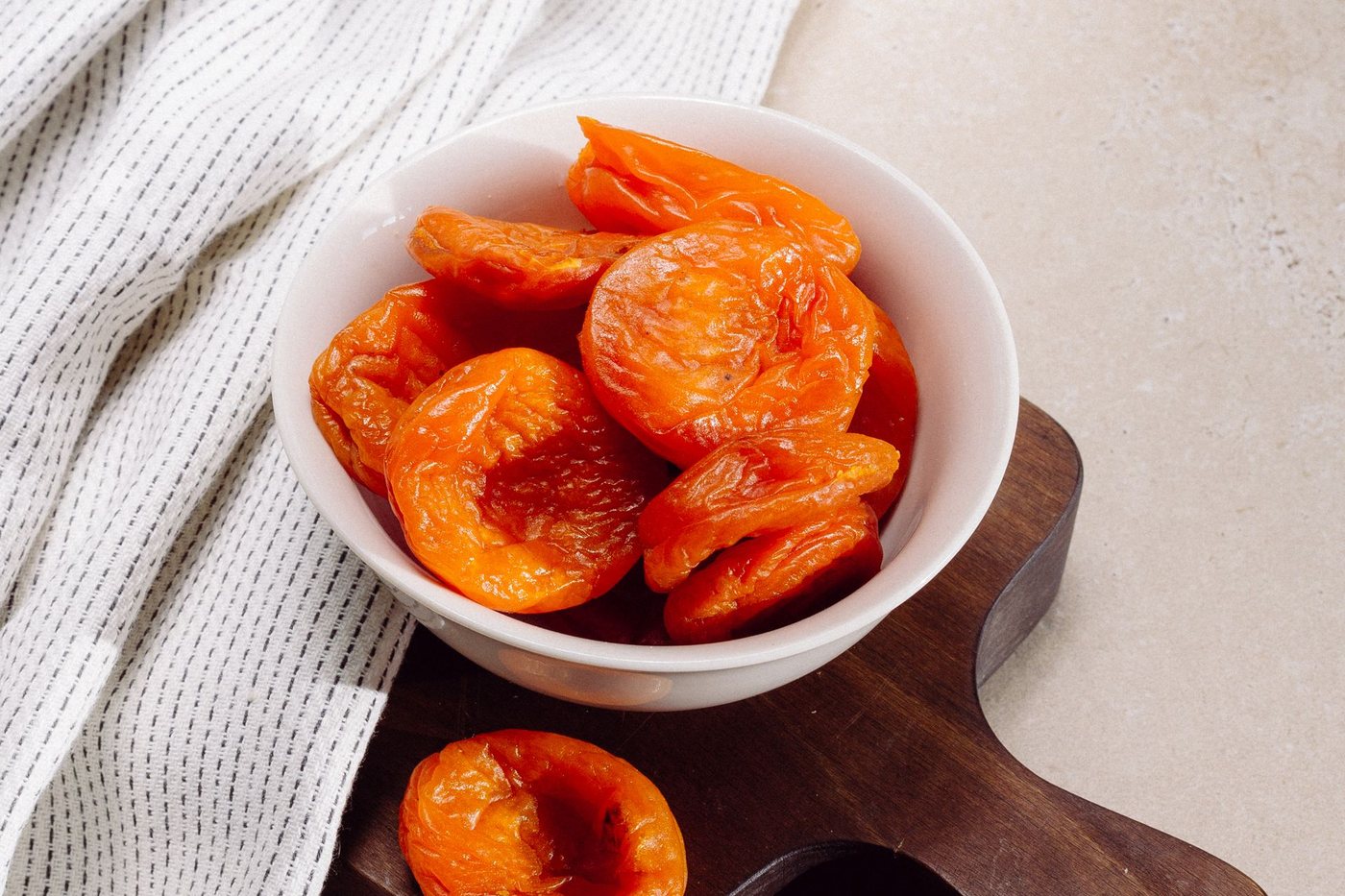
Manufacturers reach for sodium metabisulfite for three practical reasons, and the first is visible in the photograph above. It keeps dried fruit looking like fruit. Dried apricots treated with sulfites stay bright orange; untreated ones turn brown. That colour difference is the reason the EU's highest sulfite maximum is for dried fruit — 2,000 mg/kg as sulfur dioxide for dried apricots, peaches, grapes, prunes and figs — roughly ten times the level allowed in wine. It is also why dried fruit is the food where a sensitive person is most likely to meet a large dose.
Second, it keeps wine and beer stable. Sulfur dioxide stops oxidation and microbial spoilage in the bottle, which is why almost all commercial wine contains it — added, or produced naturally by the yeast during fermentation. US rules cap total sulfur dioxide in wine at 350 ppm, and most traditionally processed wines contain 0 to 150 ppm. Wine made from organically grown grapes must contain less than 100 ppm. There is no wine that is entirely sulfite-free: fermentation alone produces some, so "no added sulfites" is the honest wording, not "sulfite-free".
Third, it preserves cosmetics and makes hair dye work. In cosmetics it is listed as an allowed preservative in the EU at up to 0.2% as free sulfur dioxide, and as an antioxidant and reducing agent in oxidative hair colour, where it helps the dye chemistry along. The cosmetics safety panel's original assessment found the bisulfite form used at very low concentrations — 0.03% to 0.7% — in most products except wave sets. It also turns up in some medicines, where the same preservative job applies.
None of that is secret or unusual: sulfites have been used this way for decades, and every regulator in this article permits them. The question is not whether they work — they do — but who they harm, at what dose, and whether the safety numbers behind the permissions still hold up. That is the next two sections.
Related: Sodium Benzoate (E211): The Preservative Behind the Benzene Question
The concern: sulfite sensitivity and asthma
The documented risk from sulfites is not a general-population risk. It is a sensitivity concentrated in people with asthma, and the evidence for it is unusually concrete — because it was measured in challenge studies, in which people were given sulfites under medical supervision and their breathing was measured.
How common is it? The honest answer is a range, and the range depends on who was studied. A 2009 review put the figure at 3 to 10% of people with asthma. The best primary study behind that range is Bush and colleagues (1986): 203 asthmatic patients — 120 non-steroid-dependent and 83 steroid-dependent — were challenged with oral capsules of potassium metabisulfite. Twenty-one reacted on a single-blind screen; 12 of those were rechallenged double-blind and 4 reacted again. The authors' best estimate was 3.9% in the patients studied — and because their sample contained more steroid-dependent patients than the general asthmatic population, they concluded the prevalence in asthmatics as a whole would be less than 3.9%, with steroid-dependent asthmatics most at risk. Cleveland Clinic, medically reviewed and updated in April 2024, gives a narrower current figure: about 4% to 5% of people with asthma have some form of sulfite sensitivity. For the general population, the FDA's own wording — quoted in a university summary of the agency's position — is that the overall prevalence "is unknown and probably low", and that sensitivity is seen more frequently in asthmatic than in non-asthmatic people.
What happens: the common symptoms are wheezing, shortness of breath, chest tightness, coughing, sneezing, a stuffy or runny nose, and hives. Rarely, anaphylaxis — difficulty breathing or swallowing, flushing, a fast heartbeat, severe wheezing, dizziness, vomiting and diarrhoea. Cleveland Clinic's framing matters here: "Some people who are sensitive to sulfites don't have asthma. But people without asthma very rarely have serious reactions to sulfites." Sulfite sensitivity is usually not a true, IgE-mediated allergy — it is more common than a true sulfite allergy — and there is no reliable blood or skin test for it. Diagnosis is by history and a supervised food-challenge test, with small increasing amounts in liquid or capsule form and lung function measured by spirometer, with medication on hand.
Why it happens is not settled. Cleveland Clinic lists three candidate contributors: reactions to inhaling sulfur dioxide — sulfites release the gas, which can be inhaled when food containing them is swallowed, swelling and narrowing the airways; IgE-mediated reactions, in some people; and low levels of sulfite oxidase, the enzyme that breaks sulfur dioxide down, so some people with asthma clear sulfites less easily. Experts, the Clinic says plainly, "aren't sure what causes sulfites to trigger allergies or asthma attacks."
The wine-challenge studies are the most useful reality check on dose. In Vally and Thompson (2001), 24 asthmatic patients with a strong history of wine-induced asthma were screened; 4 of the 24 responded to a single-dose sulfited-wine challenge. In double-blind rechallenge, the four responders each had a significant fall in lung function (more than 15% from baseline) after wine containing 300 ppm sulfite — but did not respond to wines containing 20, 75 or 150 ppm. Responses peaked at 5 minutes, with a mean maximal decline in FEV1 of 28.7%, and took 15 to 60 minutes to return to baseline. A second, cumulative-dose study in the same paper — 12 wine-sensitive asthmatics against 6 control asthmatics — found no significant difference in any lung-function measure. And in Vally and colleagues (2007), 8 self-reporting wine-sensitive asthmatics showed no clinically significant fall in FEV1 after either high- or low-sulfite wine. The pattern across these studies is consistent: even among people who report wine sensitivity, only a minority react under blinded conditions, and only at sulfite levels above those in most commercial wine.
Food challenges tell the same uneven story. In Taylor and colleagues (1988), 8 sulfite-sensitive asthmatics diagnosed by double-blind capsule challenges were given sulfited foods: 4 of the 8 failed to respond to any sulfited food at all, while the others had decreased lung function with sulfited lettuce, and two of three reacted to dried apricots and white grape juice; none reacted to sulfited shrimp. The authors' conclusion is the one this article repeats: a sulfite-sensitive person with asthma "will not necessarily react after ingestion of sulfited foods. The likelihood of a reaction is dependent on the nature of the food, the level of residual sulfite, the sensitivity of the patient, and perhaps on the form of residual sulfite."
The severe end of the record dates from the salad-bar era — and it is why the rules exist. The WHO/JECFA monograph records life-threatening reactions and the deaths of 4 asthmatic people following restaurant meals including foods treated with sulfites in the early 1980s: two samples of lettuce contained 78 and 409 ppm sulfite, and guacamole contained 272 ppm. One sulfite-sensitive asthmatic lapsed into a coma after a meal including cottage-fried potatoes containing 2,240 ppm sulfite before cooking, remained comatose for 3 weeks, and 6 months later still had motor and neurological deficits. A fatal anaphylactic reaction was reported in a 33-year-old man with chronic steroid-dependent asthma after only a few sips of white wine containing 92 ppm sulfites. These cases are from before the 1986 US ban on sulfites on raw fruit and vegetables, and they were in asthmatics (with one reported anaphylaxis case in a non-asthmatic man). They are not a picture of the current, general-population risk — they are the reason the labelling rules below were written.
Tip: if you have asthma and suspect sulfites, the test that matters is a supervised challenge, not a blood test — there is no reliable blood or skin test for sulfite allergy. Keep a note of what you ate or drank and the dose, and take it to your doctor.
Related: Methylisothiazolinone (MI): The Preservative That Became 'Allergen of the Year'
The concern, skin: contact allergy
Separate from the breathing risk, sodium metabisulfite is a skin allergen — and in 2024 it got the field's highest-profile recognition. The American Contact Dermatitis Society chose sulfites as its Allergen of the Year for 2024, "to raise awareness about this significant allergen", noting that sulfites "are not included in most screening patch test series and thus may be missed as a relevant contact allergen".
Contact allergy to sulfites is a delayed, type IV (T-cell-mediated) hypersensitivity: dermatitis or eczema usually appears 48 to 72 hours after contact, as a red, scaly, itchy, swollen rash that can blister in moderate to severe reactions. It most commonly affects the face, lips and hands. Patch testing is the gold-standard test, and sodium metabisulfite at 1% in petrolatum is the standard test allergen. If a sensitised person ingests sulfites, systemic contact dermatitis can follow, though this is rare.
Every percentage in this section comes from patch-test clinics — people referred for eczema or dermatitis testing — not from the general population. That distinction matters, because clinic populations are far more likely to be allergic than people walking down the street. With that stated:
- North American Contact Dermatitis Group, 2017–18: 4,885 patients patch-tested with sodium disulfite 1% in petrolatum; 132 (2.7%) had a positive reaction. The most common sites were the face (28.8%) and hands (20.5%). Positive patients were more likely to be male and over 40, and 65.2% of reactions were considered currently relevant. Personal care products were the most commonly confirmed source (18.9%), especially hair dye; only 2.3% of positives were linked to occupation.
- Belgium, 1990–2010: 2,763 patients patch-tested; 124 (4.5%) positive, with reactions considered relevant in 64.5% of cases. The face (40.3%) and hands (24.2%) were again the most frequent sites.
- United Kingdom: over a 4-month period, 183 patients were tested with both sodium sulfite and sodium metabisulfite at 1% in petrolatum. Positive reactions to sodium metabisulfite were found in 5.5% of patients, and to sodium sulfite in 3.8%; 60% of metabisulfite-positive patients were also positive to sodium sulfite.
- Australia, 2014–2023: 1,367 patients patch-tested; 87 (6.4%) positive — but only 27.6% of those reactions were considered relevant. Among the relevant cases, alcoholic beverages were the most common exposure source (50%, mostly wine) and foodstuffs next (41.7%, mostly dried fruits). No cases were occupational. The authors' conclusion is worth quoting: "SMBS contact allergy is not uncommon, but relevance can be difficult to ascertain."
- Italy, January 2024 to April 2025: 550 consecutive patients patch-tested; 16 (2.9%) positive — and none of the 16 reactions was considered relevant. The authors reported "a high prevalence of positive patch test reactions to SMB in the absence of relevance".
The pattern across these five series is the honest story: positive patch tests to sodium metabisulfite are not rare in dermatitis clinics (2.7% to 6.4%), but a positive test does not by itself prove the ingredient is causing a person's rash — relevance ranged from zero to about two-thirds. Hair dye is the most commonly confirmed personal-care source, which is why hairdressers, along with food and beverage handlers, winemakers, photographers and healthcare workers, are listed among the exposed occupations. But occupation explained only a small share of positives in the North American series.
Related: Artificial Colours: The Synthetic Dyes Behind the Hyperactivity Debate
What regulators say
Every major authority permits sodium metabisulfite — but the permissions are narrow, the numbers are specific, and the two bodies that set the dietary safety value now disagree about it. This section takes the jurisdictions in turn, because no single regulator tells the whole story.
United States — food. Sodium metabisulfite is generally recognised as safe under 21 CFR 182.3766, "when used in accordance with good manufacturing practice" — with three exceptions written into the rule itself: it is not used in meats; in food recognised as a source of vitamin B1; or on fruits or vegetables intended to be served raw to consumers or sold raw to consumers, or to be presented to consumers as fresh. (An earlier draft of this article's brief cited 21 CFR 182.3795 for this ingredient; that section is sodium sorbate, not sodium metabisulfite — 182.3766 is the correct citation.) The FDA sets no maximum amount for sulfites in food generally; the GRAS rule works through good manufacturing practice instead.
The raw-produce exception has a history. In 1986, following reports of severe reactions and deaths among sulfite-sensitive asthmatics who had eaten sulfite-treated salad-bar produce, the FDA prohibited sulfites on fruits and vegetables intended to be served raw or presented fresh (Federal Register 51:25021–25026, amending the GRAS rules on 9 July 1986). Restaurants and grocery stores had been spraying sulfite solutions on salad-bar produce to keep it looking crisp. One exception survived: sulfite use on minimally processed potatoes sliced or shredded for frying remained permitted. A later FDA rule against sulfites on fresh potatoes served unlabeled was invalidated in court on procedural grounds in 1990, and the withdrawal was published on 22 December 1994.
United States — labelling. The rule most readers will actually use is the 10 ppm threshold. Under 21 CFR 101.100(a)(4), a sulfiting agent added to a food that has no technical effect in that food is considered present in an insignificant amount only if no detectable amount is present — and a detectable amount is 10 parts per million or more of the sulfite in the finished food. The FDA's Food Labeling Guide puts it the same way: sulfites with no technical effect are incidental only below 10 ppm. But a sulfiting agent that does have a technical or functional effect must be declared in the ingredient list by its common or usual name, regardless of the level — and naturally occurring sulfites, for example in onions, garlic and cabbage, are not required to be declared. In the US, sulfites are handled under this separate labelling rule, not the major-allergen "Contains" statement. For wine, beer and spirits, the Alcohol and Tobacco Tax and Trade Bureau requires the statement "Contains sulfites" where sulfur dioxide or a sulfiting agent is detected at 10 ppm or more, measured as total sulfur dioxide.
United States — cosmetics and drugs. There is no FDA cosmetic concentration limit for sodium metabisulfite verified in this research. The safety judgement comes from the Cosmetic Ingredient Review Expert Panel, which concluded in 2003 that sodium metabisulfite and the other sulfites in its group "are safe as used in cosmetic formulations", and confirmed that conclusion in a 2023 re-review after reopening the file because of increased use, reports of contact sensitisation, and questions about asthmatic responses and mutagenicity. The panel's 2003 report records the bisulfite form used at 0.03% to 0.7% in most products, and notes that sodium metabisulfite at 50% was irritating to guinea pigs on repeated exposure, while the undiluted material was not an irritant to rabbits under occlusive exposure.
European Union — food. Sodium metabisulfite is authorised as a member of the group "sulphur dioxide – sulphites (E 220 – E 228)" in Annex II to Regulation (EC) No 1333/2008; there is no separate E223-only entry, and the group shares the same category list and maxima, expressed as sulfur dioxide. The EU category table — as reproduced in two independent compilations that agree with each other, and corroborated by the UK's pre-2008 implementation of the same limits — puts the highest maximum at 2,000 mg/kg for dried apricots, peaches, grapes, prunes and figs, with 1,000 mg/kg for dried bananas, 600 mg/kg for dried apples and pears, and 500 mg/kg for other dried fruit. Other notable maxima include 800 mg/kg for horseradish pulp, 400 mg/kg for dehydrated potato products, 450 mg/kg for breakfast sausages and burger meat, 200 mg/kg for cider and perry, and 20 mg/kg for beer. An SO2 content of not more than 10 mg/kg or 10 mg/l is not considered to be present.
European Union — allergen labelling. Under Regulation (EU) No 1169/2011, Annex II, item 12, "sulphur dioxide and sulphites at concentrations of more than 10 mg/kg or 10 mg/litre in terms of the total SO2" must be declared — one of the 14 allergens in the annex, and the only one with a threshold. The regulation lists no exemptions for this allergen.
European Union — cosmetics. Sodium metabisulfite is listed as an allowed preservative in Annex V (positive list of preservatives), entry 9, "Inorganic sulphites and hydrogen-sulphites", at a maximum authorised concentration of 0.2% as free SO2, with no product-type restriction or warning wording in the entry. It is also used as an antioxidant and reducing agent in cosmetics, for example in oxidative hair colour, which is a separate function from its Annex V preservative listing. No separate hair-dye concentration limit was verified in this research, so none is quoted here.
Europe's safety value — withdrawn. In 2016, EFSA's re-evaluation set a temporary group acceptable daily intake (ADI) of 0.7 mg SO2 equivalent/kg body weight per day, from a no-observed-adverse-effect level of 70 mg/kg bw/day in a long-term rat study with a default uncertainty factor of 100 — and found exposure estimates already above that ADI for all population groups. In its 2022 follow-up, the panel found no new biological or toxicological data had been submitted to fill the gaps, considered the toxicity database inadequate to derive an ADI, and withdrew the temporary group ADI entirely. It switched to a margin-of-exposure approach, with a benchmark-dose lower confidence limit of 38 mg SO2 equivalents/kg bw/day — lower than the previous 70 mg/kg reference point — based on prolonged visual evoked potential latency, a neurotoxicity signal in animals. At the top of the 95th percentile exposure ranges, margins of exposure fell below its threshold of 80 for all population groups except adolescents, which the panel said "raises a safety concern for both dietary exposure scenarios". EFSA's own news summary put it plainly: "Dietary intakes of sulfites could be a safety concern for high consumers… Gaps in toxicity data meant the extent of certain adverse health effects could not be confirmed." The additives remain authorised in the EU — the 2022 opinion is a safety assessment, not a ban — and no EU ban or maximum-level change had followed as of the sources read. A 2025 EFSA exposure update found the highest exposures in toddlers, with a refined-scenario 95th percentile of 1.40 mg SO2 equivalents/kg bw/day, and the main contributors were wine, beer and meat preparations in adults and the elderly, fruit and vegetable juices and flavoured drinks in adolescents and children, and dried fruits and vegetables in infants and toddlers.
The international value — still standing. The Joint FAO/WHO Expert Committee on Food Additives (JECFA) allocated a group ADI of 0–0.7 mg/kg bw as SO2 in 1998 and has kept it since, based on long-term rat studies including a three-generation reproductive-toxicity study, with a no-effect level of 0.25% sodium metabisulfite in the diet — equivalent to 70 mg/kg bw/day of sulfur dioxide equivalents — and a safety factor of 100. At higher doses, above 1%, local irritation of the stomach was observed. The same number, opposite current status: JECFA keeps 0.7, EFSA withdrew it.
Codex and the rest of the world. The Codex General Standard for Food Additives lists sulfites (INS 223) in 59 food categories, with dried fruit at 1,000 mg/kg as residual SO2 — except dried apricots at 2,000 mg/kg and bleached raisins at 1,500 mg/kg. In Australia and New Zealand, the Food Standards Code (Schedule 15) permits the group "220 221 222 223 224 225 228 — sulphur dioxide and sodium and potassium sulphites" across 39 food categories, with the highest permitted level at 3,000 mg/kg for other dried fruit and vegetables and for imitation fruit; wine is permitted at 250 mg/kg below 35 g/L residual sugars and 400 mg/kg above it. Added sulfites must be declared at 10 mg/kg or more under Standard 1.2.3, and plain-English allergen labelling rules apply to food manufactured after 25 February 2024, with the two-year stock-in-trade period ending 25 February 2026. In Canada, Health Canada's List of Permitted Preservatives (item S.9) allows sodium metabisulfite in 18 uses, including dried fruits and vegetables at 2,500 ppm and wine at 70 ppm free or 350 ppm combined.
US state bans. Sodium metabisulfite is not named in the two state food-additive laws checked for this article: California's AB 418 (signed 7 October 2023, effective 1 January 2027) bans four substances — brominated vegetable oil, potassium bromate, propylparaben and Red dye 3 — and West Virginia's HB 2354 (passed 14 March 2025, signed 24 March 2025) bans seven synthetic colour additives plus butylated hydroxyanisole and propylparaben, with school nutrition programs covered from 1 August 2025 and a statewide sale ban from 1 January 2028. No exhaustive 50-state search was run, so this article does not claim no US state bans sulfites — only that these two laws do not name it.
Workplace exposure. For people who handle the powder at work, the US National Institute for Occupational Safety and Health recommends an exposure limit of 5 mg/m3 as a time-weighted average; the Occupational Safety and Health Administration sets no permissible exposure limit for it. The New Jersey Department of Health fact sheet states that breathing sodium metabisulfite can irritate the nose, throat and lungs, that it "may cause an asthma-like allergy", and that future exposure can cause asthma attacks — and that repeated exposure may cause bronchitis.
Advocacy databases. EWG Skin Deep — an advocacy organisation, not a regulator — rates sodium metabisulfite 2–6 on its 1–10 hazard scale, with "Fair" data availability. The 2–6 range is read from the score graphic on the page, which prints no single number in its text; the score is higher for products that may be inhaled, such as sprays and powders, and lower for solids and liquids and for products meeting safety guidelines. EWG's stated concerns are use restrictions (high), irritation of skin, eyes or lungs (high), allergies and immunotoxicity (moderate), and occupational hazards (moderate). Hair colour and bleaching is the largest product category in its database for this ingredient. The score is EWG's own hazard rating, presented here alongside the CIR conclusion and the EU limit — never as a regulatory verdict. EWG itself notes the ingredient is "designated as safe for general or specific, limited use in food" by the US FDA.
The debate
The case that sulfites are a settled, safe ingredient
The permissions are broad and consistent: the FDA calls sodium metabisulfite generally recognised as safe, the EU authorises it with maximum levels, Australia and New Zealand permit it across 39 food categories, Codex lists it in 59, and the cosmetics panel has twice concluded it is safe as used. The harm is concentrated in a small, identifiable group — mainly steroid-dependent asthmatics — and the labelling rules are built around them: a 10 ppm declaration threshold on three continents, a "Contains sulfites" statement on wine, and a 1986 ban that removed the single most dangerous use, spraying sulfites on raw salad-bar produce. Even among self-reported wine-sensitive asthmatics, blinded challenges find only a minority react, and only at 300 ppm — above the level in most commercial wine. On this view, the system works: the ingredient is safe for most people, the sensitive minority is warned, and the numbers are conservative.
The case that the safety numbers no longer hold up
Europe's own food safety authority withdrew the sulfite intake value in 2022 — not because new harm was found, but because nobody supplied the data to fill the gaps identified in 2016, and the reference point had to be cut from 70 to 38 mg/kg bw/day on an animal neurotoxicity endpoint. Even under the old value, EFSA found exposure above the ADI for every population group, and in 2022 the margins of exposure at the top of the 95th percentile fell below its safety threshold for every group except adolescents. The additives stay authorised while the value that justified them is gone — a permission without its arithmetic. Add the skin evidence: sulfites were the 2024 Allergen of the Year, patch-test positivity in dermatitis clinics runs 2.7% to 6.4%, and the ingredient is missing from most screening series, so cases are missed. On this view, "safe for most people" is true but incomplete: the dietary safety case rests on data the regulator itself says is inadequate, and the people most affected are the ones least likely to be tested for it.
Who should avoid it, or patch-test first
Most people do not need to avoid sodium metabisulfite. The groups below are the exceptions, and each one has a different reason.
- People with asthma, especially steroid-dependent asthma. This is the group with the documented risk. If you have asthma and have ever wheezed or felt short of breath after wine, dried fruit, or a restaurant salad, tell your doctor — and note that the reaction depends on the food and the dose, not just on the ingredient being present. Do not self-test with a large dose of dried apricots: diagnosis is a supervised challenge, with medication on hand.
- People who have reacted to wine or dried fruit before. Wine at 300 ppm provoked reactions in the challenge studies; most commercial wine sits well below that, and dried fruit can carry far more sulfite than wine. If you react to one sulfited food, you will not necessarily react to another — the food, the level and your own sensitivity all matter.
- People with eczema or dermatitis on the face, lips or hands — especially after hair dye. Hair dye is the most commonly confirmed personal-care source of sulfite contact allergy. If a rash appears 48 to 72 hours after colouring, ask your dermatologist for a patch test including sodium metabisulfite at 1% in petrolatum — and note that sulfites are not in most screening series, so the test has to be requested. A positive patch test alone does not prove the ingredient is causing your rash: relevance has to be judged case by case, and in the Australian and Italian series most positives were not considered relevant.
- People who handle the powder at work. Hairdressers, winemakers, food and beverage handlers, photographers and healthcare workers are among the exposed occupations. The workplace limit is 5 mg/m3 as a time-weighted average, and breathing the dust can irritate the nose, throat and lungs.
- Everyone else. There is no evidence in this research that avoiding all sulfites improves asthma in people who are not sensitive to them, and sulfites remain authorised at regulated levels in every jurisdiction covered here. Avoiding them is a precautionary or preference choice, not a health requirement — unless you are in one of the groups above.
One more honest note: sulfites are not among the ingredients this guide would tell a pregnant reader to worry about on the evidence found — but no pregnancy-specific study of sodium metabisulfite was found in this research either, so this article makes no pregnancy claim either way.
How to spot it on a label — and what to use instead
Spotting sulfites is easier than spotting most ingredients in this guide, because the labelling rules are unusually strict. On food, look for any of the family names in the ingredient list: sulfur dioxide, sodium sulfite, sodium bisulfite, potassium bisulfite, sodium metabisulfite, potassium metabisulfite — or the E numbers E220 to E228. In the US, the EU and Australia, added sulfites at 10 mg/kg or 10 ppm or more must be declared; below that, a functional use must still be declared at any level, while a use with no technical effect may go undeclared. On wine, beer and spirits, the words to look for are "Contains sulfites" (US) or the equivalent allergen declaration (EU, Australia), which appears at 10 ppm and above. Dried fruit is the food to check first: it carries the highest permitted levels, and unsulfured dried fruit — which will be brown rather than bright orange — is the straightforward swap. Fresh fruit and vegetables carry no added sulfites at all, and sulfites have been banned on raw produce served fresh in the US since 1986.
On cosmetics, look for the INCI name "sodium metabisulfite" and its relatives — sodium sulfite, sodium bisulfite, potassium sulfite, potassium metabisulfite — in the ingredient list. The EU caps it at 0.2% as free sulfur dioxide as a preservative, and the cosmetics panel calls it safe as used, so its presence is not by itself a reason to reject a product. If you have reacted to hair dye before, the practical steps are a patch test that includes sodium metabisulfite, telling the salon about the reaction, and asking what the dye contains — the ingredient will be on the professional product's list even when it is not on the box you take home.
What not to do: do not buy "sulfite-free" wine expecting zero sulfites — fermentation produces them, so the honest claim is "no added sulfites". Do not assume a product is sulfite-free because it says "natural" or "organic" — organic wine still contains sulfites, capped below 100 ppm in the US. And do not treat the EWG 2–6 range as a safety verdict: it is an advocacy hazard screen, and the regulators that actually set limits — the FDA, the EU, FSANZ and JECFA — all permit this ingredient within their limits, while disagreeing, honestly, about how much data is enough.
Related: Added Sugars: The Sweetener Hiding in Plain Sight — and Why the Numbers Disagree
Frequently asked questions
Is sodium metabisulfite the same as sulfates?
No. Sulfites (including sodium metabisulfite, E223) release sulfur dioxide and are used as preservatives and antioxidants. Sulfates are salts of sulfuric acid — the cleansing agents in many shampoos — and sulfites do not cross-react with them. Sulfites are also not sulfa drugs, and a sulfa-drug allergy does not predict a sulfite reaction.
Is sodium metabisulfite safe?
For most people, at regulated levels, the regulators say yes: the FDA lists it as generally recognised as safe, the EU authorises it with maximum levels, and the Cosmetic Ingredient Review panel calls it safe as used, re-confirmed in 2023. The caveat is real: EFSA withdrew its dietary intake value for sulfites in 2022 because the toxicity data were too thin, while JECFA still keeps the same 0–0.7 mg/kg bw/day value. And a small group — mainly people with asthma, especially steroid-dependent asthma — can have serious reactions.
Why does my wine say 'Contains sulfites'?
Because the law requires it at 10 ppm of total sulfur dioxide or more — in the US since 1987, under the same 10 ppm threshold used in the EU and Australia. Almost all commercial wine contains sulfites, added or produced naturally by the yeast during fermentation. US rules cap total sulfur dioxide in wine at 350 ppm, and most traditionally processed wines contain 0 to 150 ppm. No wine is entirely sulfite-free.
Can sulfites affect me if I don't have asthma?
Serious reactions in people without asthma are very rare, according to Cleveland Clinic. Sulfite sensitivity is seen more frequently in asthmatic than in non-asthmatic people, and the documented severe cases — including the deaths recorded in the early 1980s — were in asthmatics. A separate issue is skin allergy: sodium metabisulfite can cause allergic contact dermatitis, usually on the face, lips and hands, most often linked to hair dye — and that can affect people without asthma.
What does the 10 ppm rule mean on a label?
Ten parts per million of total sulfur dioxide is the declaration threshold in the US, the EU and Australia: added sulfites at or above 10 ppm (or 10 mg/kg) must be declared. But a sulfite that has a technical or functional effect in the food must be declared at any level, and naturally occurring sulfites — for example in onions, garlic and cabbage — do not have to be declared at all.
How do I avoid sodium metabisulfite?
On food, look for the family names (sulfur dioxide, sodium sulfite, sodium bisulfite, potassium bisulfite, sodium metabisulfite, potassium metabisulfite) or the E numbers E220 to E228, and choose dried fruit labelled unsulfured — it will be browner, which is the trade-off. On cosmetics and hair dye, check the ingredient list for sodium metabisulfite and the other sulfite salts, and patch-test hair dye first if you have reacted before. If you have asthma and suspect sulfites, ask your doctor about a supervised challenge rather than testing yourself.
Checked against 21 CFR 182.3766, EFSA Journal 2022;20(11):7594, JECFA WHO Food Additives Series 42, the CIR 2003 and 2023 assessments, Cleveland Clinic and EWG Skin Deep (advocacy source) · Last updated 2026-11-19 · How we assess ingredients
Sources (40)
- US eCFR, 21 CFR 182.3766 — Sodium metabisulfite: generally recognised as safe when used in accordance with good manufacturing practice, except in meats, in food recognised as a source of vitamin B1, and on fruits or vegetables intended to be served raw (current to 16 Nov 2026)
- University of Nebraska–Lincoln FARRP, 'Sulfites — USA': the 1986 ban on sulfites on raw fruit and vegetables (Federal Register 51:25021–25026), the salad-bar history, the potato exception, and the 1990 court invalidation of the fresh-potato rule
- US FDA Food Labeling Guide: sulfites with no technical effect are incidental only below 10 ppm (21 CFR 101.100(a)(3) & (4))
- US FDA Import Alert 99-21 (rev. 28 Jul 2023): sulfiting agents with a technical or functional effect must be declared by common or usual name regardless of level; naturally occurring sulfites need not be declared
- Alcohol and Tobacco Tax and Trade Bureau, SSD:TM:500 Rev. 6: wine cap 350 ppm total sulfur dioxide (27 CFR 4.22(b)(1)); 'Contains sulfites' at 10 ppm or more (27 CFR 4.32(e)); most traditionally processed wines 0–150 ppm; organic wine below 100 ppm
- Food Additive Index, sodium metabisulfite — secondary compilation of the EU (Regulation (EC) No 1333/2008, Annex II), FSANZ (Schedule 15) and Health Canada (List 11) category tables, corroborated against the UK SI 1995/3187 for the EU figures: dried apricots 2,000 mg/kg, 41 EU categories, 39 ANZ categories, 59 Codex categories
- EUR-Lex, Regulation (EU) No 1169/2011, Annex II item 12: 'Sulphur dioxide and sulphites at concentrations of more than 10 mg/kg or 10 mg/litre in terms of the total SO2' must be declared
- Regulation (EC) No 1223/2009, Annex V entry 9 (UK-retained text): 'Inorganic sulphites and hydrogen-sulphites', including sodium metabisulfite (CAS 7681-57-4), maximum 0.2% as free SO2
- Nair B, Elmore AR (2003) Int J Toxicol 22 Suppl 2:63–88 (PMID 14555420): Cosmetic Ingredient Review Expert Panel concluded sodium metabisulfite and the other sulfites in the group 'are safe as used in cosmetic formulations'; bisulfite form used at 0.03% to 0.7% in most products
- Johnson W Jr et al. (2023) Int J Toxicol 42(3 Suppl):110S–114S (PMID 37843013): Expert Panel for Cosmetic Ingredient Safety reviewed newly available studies since the original assessment and confirmed the sulfites 'are safe as cosmetic ingredients in the practices of use and concentration as described in this report'
- EFSA ANS Panel (2016) EFSA Journal 14(4):4438: temporary group ADI 0.7 mg SO2 equivalents/kg bw/day from a NOAEL of 70 mg/kg bw/day; exposure estimates above the ADI for all population groups; no genotoxicity concern
- EFSA Panel on Food Additives and Flavourings (2022) EFSA Journal 20(11):7594: no new data submitted, toxicity database inadequate to derive an ADI, temporary group ADI withdrawn; benchmark-dose lower confidence limit 38 mg SO2 equivalents/kg bw/day; margins of exposure below 80 at the maximum of 95th percentile ranges for all groups except adolescents
- EFSA news, 24 Nov 2022: 'Dietary intakes of sulfites could be a safety concern for high consumers… Gaps in toxicity data meant the extent of certain adverse health effects could not be confirmed'
- EFSA (2025) technical report, doi:10.2903/sp.efsa.2025.EN-9754: highest refined-scenario exposure in toddlers (mean 0.43, 95th percentile 1.40 mg SO2 equivalents/kg bw/day); main contributors wine, beer and meat preparations (adults/elderly), fruit/vegetable juices and flavoured drinks (adolescents/children), dried fruits and vegetables (infants/toddlers)
- WHO Food Additives Series 42 (51st JECFA, 1999): group ADI 0–0.7 mg/kg bw as SO2 maintained; NOEL 0.25% sodium metabisulfite in the diet (70 mg/kg bw/day SO2 equivalents), safety factor 100; stomach irritation above 1%
- WHO JECFA database, sulfur dioxide (chemID 985): evaluation year 1998, group ADI 0–0.7 mg/kg bw, covering sodium metabisulfite among the sulfites
- Codex Alimentarius, General Standard for Food Additives (CXS 192-1995): sulfites (INS 223) in 59 food categories; dried fruit 1,000 mg/kg as residual SO2, except dried apricots 2,000 mg/kg and bleached raisins 1,500 mg/kg
- Food Standards Australia New Zealand, Food Standards Code, Schedule 15 (legislation.gov.au): group '220 221 222 223 224 225 228 — sulphur dioxide and sodium and potassium sulphites' across 39 food categories; highest permitted level 3,000 mg/kg
- Australian Department of Agriculture, Fisheries and Forestry, Imported Food Notice IFN 10-25 (14 Oct 2025): sulphites must be declared at 10 mg/kg or more; plain-English allergen labelling under Standard 1.2.3 and Schedule 9–3; food manufactured after 25 February 2024 must comply; stock-in-trade period ends 25 February 2026
- Cleveland Clinic, 'Sulfite Sensitivity' (medically reviewed, updated 24 Apr 2024): about 4% to 5% of people with asthma have some form of sulfite sensitivity; mechanism not settled (three candidate contributors); symptoms; no reliable blood or skin test; diagnosis by history and supervised challenge
- Bush RK et al. (1986) Am J Med 81(5):816–820: prospective single-blind screening of 203 asthmatic patients (120 non-steroid-dependent, 83 steroid-dependent); 21 reacted single-blind, 12 rechallenged double-blind, 4 reacted again; best estimate 3.9% in the studied sample, less for asthmatics as a whole
- Vally H, Thompson PJ (2001) Thorax 56(10):763–769: in 24 wine-sensitive asthmatics, 4 responded to a single-dose sulfited-wine challenge; in double-blind rechallenge the four responders each had a fall in FEV1 of more than 15% after wine containing 300 ppm sulfite, but not after 20, 75 or 150 ppm; cumulative-dose study (12 vs 6 controls) found no significant difference
- Taylor SL et al. (1988) J Allergy Clin Immunol: sulfited-food challenges in 8 sulfite-sensitive asthmatics — 4 of 8 failed to respond to any sulfited food; the others reacted to sulfited lettuce, and two of three to dried apricots and white grape juice; none reacted to sulfited shrimp
- Vally H et al. (2007) Clin Exp Allergy: 8 self-reporting wine-sensitive asthmatics, double-blind high- vs low-sulfite wine challenges — none showed a clinically significant (15% or more) reduction in FEV1 with either wine
- Ekstein SF, Warshaw EM (2024) Dermatitis 35(1):6–12 (PMID 37590472): the American Contact Dermatitis Society chose sulfites as the Allergen of the Year for 2024; sulfites are not included in most screening patch test series and may be missed
- Warshaw EM et al. (2021) Contact Dermatitis 85(3):285–296 (NACDG 2017–2018): 4,885 patients patch-tested with sodium disulfite 1% in petrolatum; 132 (2.7%) positive; face 28.8%, hands 20.5%; 65.2% currently relevant; personal care products the most commonly confirmed source (18.9%), especially hair dye; only 2.3% occupational
- Garcia-Gavin J et al. (2012) Contact Dermatitis 67(5):260–269: Belgian series 1990–2010, 2,763 patients patch-tested with sodium metabisulfite; 124 (4.5%) positive; reactions relevant in 64.5%
- Brasher K, Palmer A, Nixon R (2026) Contact Dermatitis 95(5):461–474 (PMID 42486535): Australian series 2014–2023, 1,367 patients patch-tested to 1.0% sodium metabisulfite in petrolatum; 87 (6.4%) positive, 27.6% relevant; alcoholic beverages the most common relevant source (50%, mostly wine), foodstuffs next (41.7%, mostly dried fruits)
- Casciola C et al. (2026) Contact Dermatitis 94(2):166–172 (PMID 41194600): Italian series Jan 2024–Apr 2025, 550 consecutive patients; 16 (2.9%) positive for sodium metabisulfite; none of the 16 reactions was considered relevant
- DermNet, 'Contact allergy to sulphites' (last reviewed Aug 2025): delayed type IV hypersensitivity, dermatitis 48–72 hours after contact, face/lips/hands most commonly affected; patch testing the gold-standard test; sulfites distinct from sulfates and do not cross-react
- EWG Skin Deep, Sodium Metabisulfite ingredient page — ADVOCACY organisation, not a regulator: score range 2–6 on its 1–10 hazard scale (read from the score graphic; no single number is printed in the page text), data availability 'Fair'; concerns: use restrictions (high), irritation (high), allergies and immunotoxicity (moderate)
- NIOSH Pocket Guide via CAMEO Chemicals (NOAA): sodium metabisulfite — recommended exposure limit TWA 5 mg/m3; OSHA permissible exposure limit: none; target organs eyes, skin, respiratory system
- New Jersey Department of Health, Right-to-Know fact sheet 1708 (rev. Aug 2005): breathing sodium metabisulfite can irritate the nose, throat and lungs; it 'may cause an asthma-like allergy' and repeated exposure may cause bronchitis
- California AB 418 (California Food Safety Act), bill text as amended in Senate 3 Jul 2023: bans four substances (brominated vegetable oil, potassium bromate, propylparaben, Red dye 3); signed 7 Oct 2023, effective 1 Jan 2027; sodium metabisulfite is not named
- West Virginia HB 2354, enrolled bill text: bans seven synthetic colour additives plus butylated hydroxyanisole and propylparaben; passed 14 Mar 2025, signed 24 Mar 2025; school nutrition programs from 1 Aug 2025, statewide sale ban from 1 Jan 2028; sodium metabisulfite is not named
- University of Florida IFAS Extension FY731, 'Sulfites: Separating Fact from Fiction' (rev. May 2022): the 1985 FASEB report concluded sulfites 'are safe for most people, but could pose a hazard of unpredictable severity to asthmatics and others who are sensitive to them'; adverse reactions in non-asthmatics 'extremely rare'
- JECFA, WHO Food Additives Series 21 (1987 monograph), 'Observations in humans — Case studies': life-threatening reactions and deaths of 4 asthmatic individuals after restaurant meals with sulfite-treated foods (lettuce 78 and 409 ppm, guacamole 272 ppm); coma case after cottage-fried potatoes at 2,240 ppm; fatal anaphylaxis in a 33-year-old man after white wine at 92 ppm
- Sigma-Aldrich, sodium metabisulfite product page: formula Na2S2O5, CAS 7681-57-4, molecular weight 190.11, EC number 231-673-0
- Napa Valley Wine Academy, 'Sulfites in Wine': 'Contains Sulfites' required in the US since 1987 at 10 ppm or more of total sulfur dioxide; federal maximum 350 ppm
- LabelReader, 'Sulfites on Food Labels' — secondary summary: sulfites are not major food allergens under US law and should not be listed in the major-allergen 'Contains' statement; 21 CFR 130.9 applies the same 10 ppm threshold in standardised foods